Home
Compliance

General Safety Accreditation (GSA): the foundation of heavy vehicle accreditation

The mandatory base tier of the scheme that replaced NHVAS

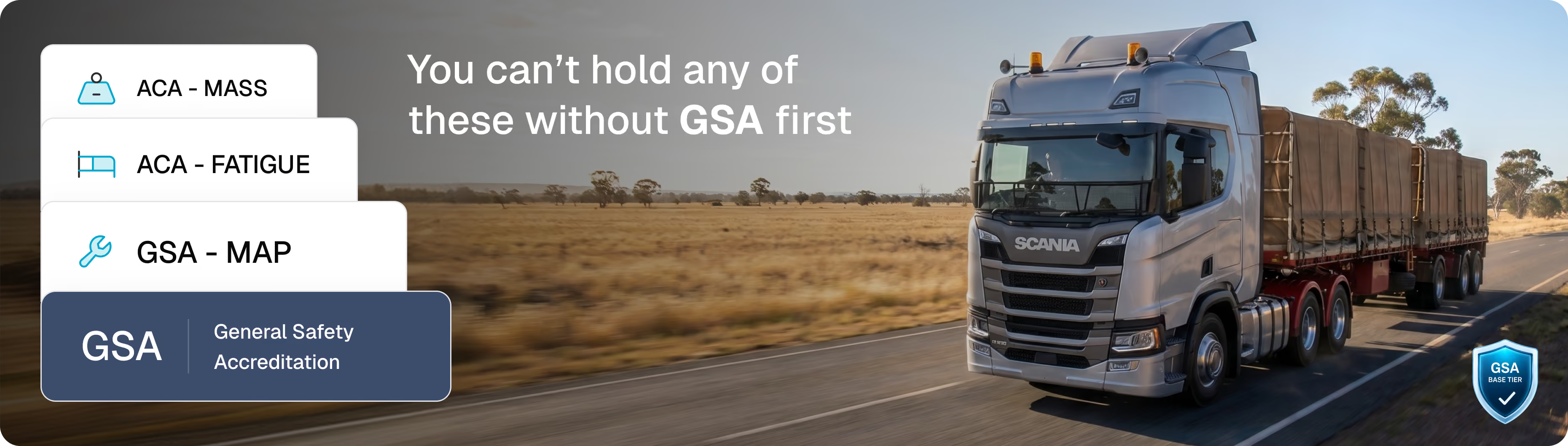
Since 1 August 2026, the National Heavy Vehicle Accreditation Scheme (NHVAS) has been progressively replaced by the Heavy Vehicle Accreditation (HVA) scheme. General Safety Accreditation (GSA) sits at the base of it. Every other accreditation now builds on top of GSA — you cannot hold fatigue, maintenance or mass accreditation without it.

Whole-of-business assessment | SMS Standard 2026 | PSOE audit evidence | Three-year transition

Icon
Built around the 2026 SMS Standard that GSA is assessed against
Icon
Evidence collected as your week happens, not the fortnight before an audit

Why GSA is different to NHVAS

Icon
Whole-of-business, not module by module
Icon
Mandatory foundation — nothing sits above it without it
Icon
Assessed on outcomes, not a checklist
Icon
Audited on PSOE — Present, Suitable, Operating, Effective

What is General Safety Accreditation?

General Safety Accreditation is a whole-of-business assessment of your Safety Management System against the 2026 SMS Standard.
Rather than accrediting you for a single activity, GSA asks whether your operation as a whole identifies its safety risks, controls them, trains people to those controls, monitors whether any of it is working, and acts when it isn't.
That is a genuine change in thinking. Under NHVAS you could be accredited in maintenance without any documented view of how you managed loading risk, driver competency, or the scheduling pressure your customers placed on your drivers. Under GSA, the standard asks about all of it.
GSA applies the same questions whether you run three trucks or three hundred. What changes with size is the depth of the answer, not the scope of the question — that is what the Suitable test in the audit exists to judge.

How GSA relates to the other accreditations

The HVA scheme has two tiers: General Safety Accreditation (GSA) as the foundation, and Alternative Compliance Accreditation (ACA) for operators who need to work outside the standard rules.
Under NHVAS
Under the HVA scheme
What it now requires
General Safety Accreditation (GSA)
Mandatory foundation. Whole-of-business assessment against the SMS Standard 2026.
Maintenance Management
GSA – Maintenance Assurance Program (MAP)
GSA, plus documented maintenance assurance under Schedule 2.
Basic and Advanced Fatigue Management (BFM / AFM)
ACA – Fatigue
GSA, plus Schedule 1. Alternative Compliance Hours replace the fixed BFM and AFM rule sets.
Mass Management
ACA – Mass
GSA, plus Schedule 3. Only needed for higher mass or PBS access, as General Mass Limits now align with Concessional Mass Limits.
The practical consequence.
Operators who previously held one module now need a working safety management system across the whole business before they can hold anything at all. For many, GSA is a larger piece of work than the module they are renewing.

Who needs GSA?

  • Operators currently accredited under NHVAS. You transition at your next accreditation cycle. The two schemes run side by side for up to three years, so your next renewal is your real deadline.
  • Operators seeking any accreditation for the first time. GSA comes first, then the ACA pathway you need.
  • Operators who need higher mass, PBS access or alternative work and rest hours. GSA is the entry ticket.
  • Operators who hold no accreditation at all. GSA is not required of you, but the primary safety duty under the HVNL still is. The SMS Standard is the clearest available description of what discharging that duty looks like, and building to it is the most direct way to demonstrate due diligence after an incident.

What GSA assesses: the five outcome areas

The SMS Standard is organised into five outcome areas. GSA assesses your operation against all five.
Blue icon of a person with a star on their chest, symbolizing leadership or achievement.
Leadership & Commitment
Documented safety policy, accountable roles, measurable safety objectives, management review, and resourcing — signed off and visibly owned by senior management.
Risk Management
Hazard identification, a consistent likelihood × severity assessment method, a maintained risk register, controls linked to specific risks, and incident investigation to root cause.
Blue user profile icon with a circular head and curved shoulders on a white background.
People
Competency requirements by role, induction, training records and expiries, licence and medical verification, and fitness for duty.
Blue circular seal with two concentric rings and a ribbon at the bottom resembling an assurance or certification badge.
Assurance, Monitoring and Improvement
KPIs across the system, internal audit, a corrective action register tracked to closure, and evidence that findings change what you do.
Shield icon with a checkmark indicating safety or protection.
Safety Systems
Policies and procedures under version control, emergency response, Chain of Responsibility documentation, and records you can retrieve on request.
For the full breakdown of each outcome area and the specific evidence an auditor looks for, see SMS Requirements Explained.

How a GSA audit works: Present, Suitable, Operating, Effective

Under the National Audit Standard, an approved auditor rates each part of your system against four tests.
Test
What it asks
What satisfies it
Present
Is it documented?
Policies, procedures, registers and records exist and can be produced.
Suitable
Does it fit this operation and its risks?
The system reflects your actual fleet, tasks, customers and risk profile — not a generic manual.
Operating
Do your people genuinely use it?
Dated records showing the system in daily use across the business.
Effective
Is it demonstrably reducing risk?
Trends, closed corrective actions, and evidence that controls changed outcomes.
Operating and Effective cannot be manufactured before an audit.
Operators who previously held one module now need a working safety management system across the whole business before they can hold anything at all. For many, GSA is a larger piece of work than the module they are renewing.
What builds that record is a closed loop. A hazard is reported, assessed for likelihood and severity, matched to a control, assigned as an action, verified, and closed. Run that loop consistently for a year and Operating and Effective stop being arguments you have to make — they are simply what your records show.

The upside: what GSA gives back

GSA is usually presented as a burden, but it changes the trade in one important way. Under ACA – Fatigue, Alternative Compliance Hours replace the fixed BFM and AFM rule sets with work and rest schedules built around your operation, inside outer limits of 15.5 hours of work and seven hours of continuous rest.

If your safety system justifies the flexibility, you get latitude the old modules never allowed. The better the system, the more freedom you earn — a real reversal, given that the safest operators previously carried the same rigid constraints as everyone else.

Preparing for GSA: where to start

1.
Write down what you already do
Most operators are doing more than they realise. It is just sitting in habits and in one experienced person's head rather than in a document an auditor can read.
2.
Link evidence to controls as the work happens
When a driver reports a defect or a hazard, that record should attach to the control it tests — at the time, not at audit time. This is the single practice that turns activity into evidence.
3.
Get your records into one place
Hazards, incidents, training, maintenance and policy acknowledgments need to sit where the connections between them are visible. A policy in a folder, certificates in a filing cabinet and incident reports scattered through an inbox can prove Present. They cannot prove Effective, because nothing joins them together.
4.
Work backwards from your next renewal
Your transition happens at your next accreditation cycle. Count back twelve months from that date — that is when your Operating and Effective evidence needs to start accumulating.

Choosing Your Rule Set:Pre-Defined or Bespoke

Under Alternative Compliance, operators have two paths to flexible fatigue management:
Outcome area
What Hubfleet provides
Leadership & Commitment
Safety category owners, escalation contacts, role-based access, and a policy library with senior management sign-off. See Policies & Procedures Management.
Risk Management
Mobile hazard reporting, a standardised likelihood × severity matrix, a unified risk register fed by every module, and controls linked to risks. See Risk Management and Risk Controls.
People
Competency requirements by role, training and certificate records with expiry alerts, induction workflows, and daily fitness-for-duty checks. See Fit for Duty.
Assurance, Monitoring and Improvement
Compliance metrics across every module, non-conformance workflows, and a corrective action register tracked to verified closure. See Non-Conformance Reporting (NCR).
Safety Systems
Version-controlled policies and procedures, acknowledgment audit trails, Chain of Responsibility documentation, and record retention. See Custom Forms & Data Capture.
For the accreditation pathways above GSA: Fatigue Management and Electronic Work Diary (EWD) for ACA – Fatigue, Maintenance Management for GSA – MAP, and Mass Management for ACA – Mass.

Frequently Asked Questions

What is General Safety Accreditation (GSA)?
GSA is the foundation tier of the Heavy Vehicle Accreditation (HVA) scheme, which began progressively replacing NHVAS on 1 August 2026. It is a whole-of-business assessment of your Safety Management System against the 2026 SMS Standard, covering leadership and commitment, risk management, people, assurance, and safety systems.
Is GSA mandatory?
GSA is mandatory for any operator who wants to hold accreditation. You cannot hold ACA – Fatigue, GSA – MAP or ACA – Mass without holding GSA first. Operators who hold no accreditation are not required to obtain GSA, but they still carry the primary safety duty under the HVNL.
What happened to my NHVAS mass, maintenance or fatigue accreditation?
Maintenance Management becomes GSA – Maintenance Assurance Program (MAP). BFM and AFM are replaced by ACA – Fatigue with Alternative Compliance Hours. Mass Management becomes ACA – Mass, which most operators will no longer need because General Mass Limits now align with Concessional Mass Limits. In every case, GSA has to be held underneath.
How long do I have to transition?
Currently accredited operators transition at their next accreditation cycle, with the two schemes running in parallel for up to three years. In practice your next renewal is the deadline, and the Operating and Effective parts of the audit need history behind them by then.
What does PSOE mean in a GSA audit?
Present, Suitable, Operating and Effective. An approved auditor rates each part of your system against these four tests under the National Audit Standard. Present means documented, Suitable means appropriate to your operation and its risks, Operating means your people genuinely use it, and Effective means it is demonstrably reducing risk.
Does GSA apply differently to small operators?
The outcome areas are the same regardless of fleet size. What changes is the depth of system that is appropriate — that judgement is what the Suitable test exists to make. A three-truck operator needs a documented, working system, not a corporate safety manual.
Can a digital system make us GSA-ready on its own?
No system makes you accredited, but the difference a digital system makes is in Operating and Effective. Those two tests depend on dated records showing daily use and demonstrable risk reduction, which is exactly what a platform produces automatically and what paper and spreadsheets cannot join together.

Get GSA-ready

Stylized blue paper airplane icon with shadow on transparent background.
Start Free Trial
Recommended for most fleets
Best if you're ready to get drivers logging now and explore Hubfleet at your own pace.
Icon
Full platform access — every feature, no limits
Icon
Drivers can start on EWD today
Icon
Real EWD, SMS, and compliance reporting from day one
Icon
No upfront costs · No lock-in contract
Start Free Trial
Icon of a calendar with blue top binder and dark gray date display area.
Book your Demo
Best for larger fleets or complex setups
Best if you've got specific integration questions, multiple sites, or want a tailored walkthrough first.
Icon
Tailored to your fleet and use case
Icon
30 minutes with a Hubfleet specialist
Icon
See the platform mapped against your fleet's compliance obligations
Icon
Get HVNL and SMS questions answered live
Book your 30-Minute Demo
Want to see plans first?
Icon
500+ Australian operators
Icon
NHVR approved
Icon
Free trial
Icon
Australian-based support