Home
Compliance

Alternative Compliance Hours (HVNL Reforms)

Flexible Fatigue Management with Operator-Specific Work and Rest Schedules

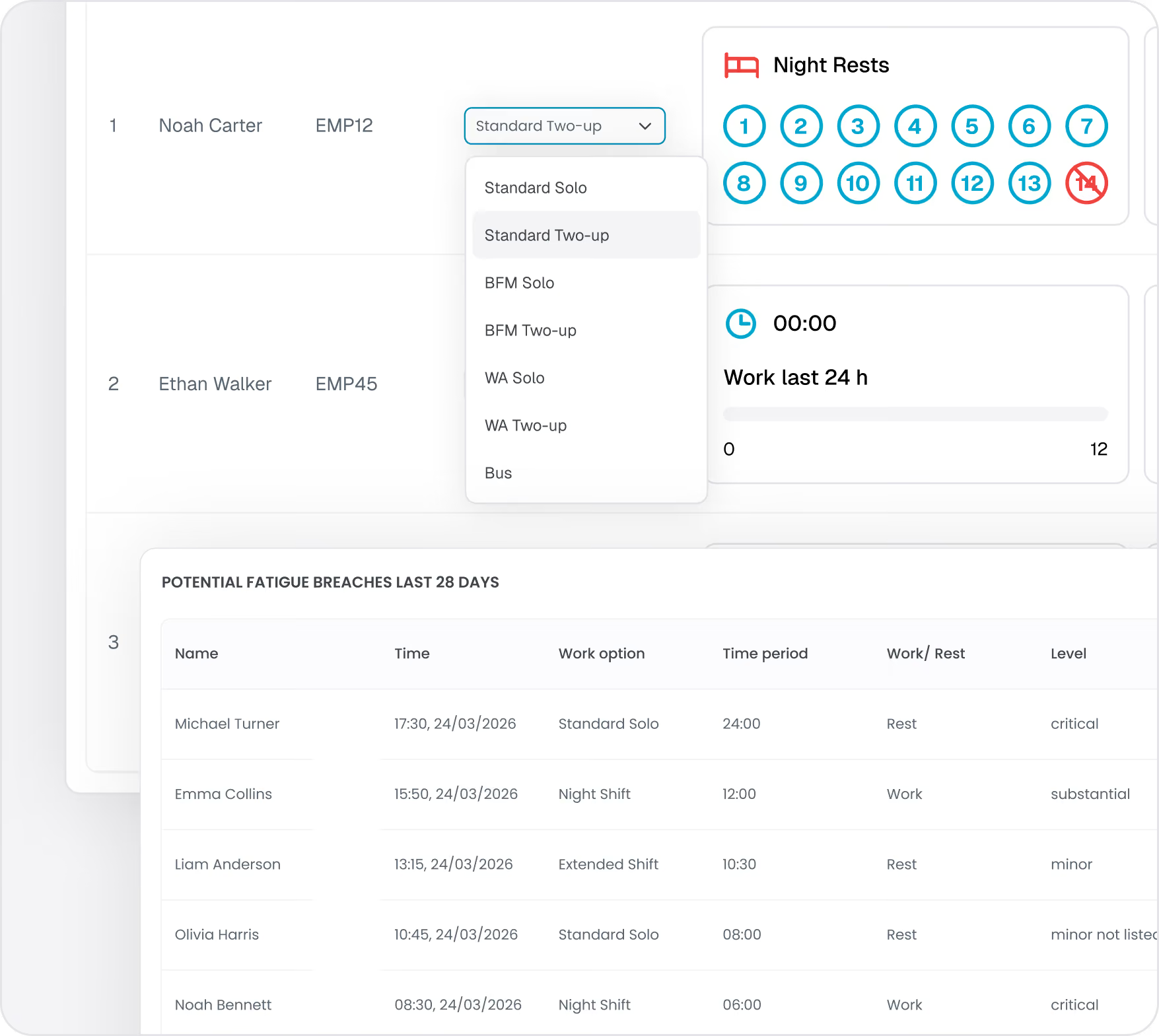
The HVNL reforms introduces Alternative Compliance Hours — a flexible approach to fatigue management that replaces BFM and AFM. The NHVR is expected to offer 8 pre-defined rule sets covering around 90% of current industry AFM usage, allowing operators to simply select a rule set that fits their operations. Hubfleet will implement all 8 rule sets, ensuring they are configured and ready to go for operators from day one. For operators with unique requirements, bespoke rule set applications will also be available.

Pre-Defined Rule Sets | Bespoke Applications | Schedule Enforcement | NHVR-Ready

Icon
Baseline and Alternative Compliance support
Icon
All 8 alternative compliance rule sets ready to go

Why Operators Choose Hubfleet for Alternative Compliance

Icon
All 8 rule sets ready — every pre-defined NHVR rule set implemented and ready for operators
Icon
Bespoke applications — apply for custom schedules if pre-defined options don't fit
Icon
Approved schedule enforcement with real-time compliance checking
Icon
Split rest controls for solo drivers with emergency use tracking
Navigate HVNL reforms fatigue flexibility with confidence

What is Alternative Compliance?

Alternative Compliance Hours is The HVNL reforms' flexible approach to fatigue management, replacing the current BFM (Basic Fatigue Management) and AFM (Advanced Fatigue Management) frameworks.
The Change from BFM/AFM to Alternative Compliance
More flexibility overall: HVNL's Alternative Compliance framework offers significantly more flexibility than the current BFM/AFM system — with pre-defined options that simplify adoption for most operators and a bespoke path for those with unique needs.
Previous system before 1 August 2026:
  • Standard Hours: Fixed work/rest limits for all operators
  • BFM: Basic flexibility with prescribed schedules
  • AFM: Advanced flexibility with approved variations
HVNL reforms system, live since 1 August 2026:
  • Baseline: Standard work/rest limits (similar to current Standard Hours)
  • Alternative Compliance: Choose from 8 pre-defined NHVR rule sets (including one similar to current BFM), or apply for a bespoke rule set — all within outer safety limits
Key Differences
What Stays the Same
  • Operators still need NHVR approval for flexible schedules
  • Risk-based approach to fatigue management
  • Breach monitoring and corrective actions
  • Evidence of systematic fatigue management
What Changes
  • 8 pre-defined rule sets available covering 90% of current industry AFM usage
  • Operators select a pre-defined rule set or apply for a bespoke rule set
  • Bespoke applications assessed using RCSM (Risk Classification System Matrix)
  • Split rest only for emergency use
  • Absolute outer limits (15.5hr work, 6hr min rest block) that no rule set can exceed
  • Evidence-based demonstration of safety

Baseline vs Alternative Compliance

HVNL introduces two tiers of fatigue management accreditation:
Blue document icon with a magnifying glass symbolizing audit readiness.
Baseline Compliance
Who it's for:
  • Operators with simple, predictable schedules
  • Operations within standard work/rest limits
  • No need for schedule flexibility
Work/Rest Limits:
  • Maximum 12 hours work in 24-hour period
  • Minimum 7 hours continuous rest
  • Standard work week limits
Requirements:
  • Basic SMS covering fatigue management
  • GPS cross-checking of work diaries
  • Breach monitoring and reporting
Advantages:
  • Simple compliance requirements
  • Minimal administrative burden
  • Suitable for most operations
  • Easy to implement and maintain
Blue document icon with a magnifying glass symbolizing audit readiness.
Alternative Compliance
Who it's for:
  • Operators needing schedule flexibility
  • Specialised industries (mining, agriculture, construction)
  • Operations with variable workloads
  • Long-distance or remote work
Two Paths to Flexibility:
  • Pre-defined rule sets: Choose from 8 NHVR rule sets covering 90% of industry needs — simplified application and faster approval
  • Bespoke rule sets: Apply for custom schedules if pre-defined options don't fit your operations
Absolute Outer Limits (cannot be exceeded):
  • Maximum 15.5 hours work in 24-hour period
  • Minimum 7 hours continuous rest (5hr minimum per block if split)
  • These are hard ceilings — no rule set can exceed them
  • Each rule set defines its own specific limits within these maximums
Requirements:
  • Everything from Baseline, plus:
  • NHVR-approved Alternative Compliance application (pre-defined or bespoke)
  • Enhanced monitoring and controls
  • Split rest tracking (emergency use only)
  • Fit for duty checks for shift workers
Advantages:
  • Pre-defined rule sets simplify transition from AFM
  • Bespoke option for unique operational needs
  • Better alignment with business needs
  • Competitive advantage in specialised industries
  • Driver satisfaction with realistic schedules

Two-Up Driver Provisions

HVNL includes specific provisions for two-up driving — where two drivers share driving duties on the same vehicle during the same trip. Two-up arrangements allow extended work periods because the non-driving driver can rest while the other drives.

Two-Up Work and Rest Limits
Solo Driver
Two-Up Driver
Maximum work in 24hrs
15.5 hours (outer limit)
14 hours
Minimum continuous rest
7 hours (or 6hr block if split)
5 hours continuous
Split rest eligible
Yes (solo drivers, emergency only)
No
Transitioning from current two-up arrangements?
If you currently operate two-up under AFM, the HVNL provisions provide a clearer framework with defined limits. Contact us for guidance on transitioning your two-up operations.
Key Rules for Two-Up Driving
  • Both drivers must hold valid fatigue accreditation
  • Rest must be taken in an approved rest facility within or attached to the vehicle
  • The non-driving period counts as rest only if the driver has access to a suitable sleeping berth
  • Each driver's hours are tracked independently
  • Two-up drivers are not eligible for split rest provisions
How Hubfleet Supports Two-Up Driving
  • Independent hour tracking — each driver's work and rest is monitored separately against the 14hr/5hr limits
  • Real-time alerts — drivers and managers are notified as limits approach
  • Audit evidence — complete trail showing which driver was driving at any point, with GPS verification

Choosing Your Rule Set:Pre-Defined or Bespoke

Under Alternative Compliance, operators have two paths to flexible fatigue management:
Path 1
Pre-Defined Rule Sets (Most Operators)
The NHVR is expected to offer 8 pre-defined rule sets that cover around 90% of current industry AFM usage. These are designed to simplify the transition from BFM and AFM to Alternative Compliance. Notably, one of the pre-defined rule sets is expected to be very similar to — if not the same as — the current BFM, providing a familiar starting point for operators currently on Basic Fatigue Management.
How it works:
  • Review the available NHVR rule sets
  • Select the rule set that best matches your operations
  • Apply to NHVR referencing your chosen rule set
  • Activate your approved rule set in Hubfleet — all 8 pre-defined rule sets will be pre-built in and ready to use
Advantages:
  • Simplified application process
  • Faster NHVR approval (rule sets are pre-assessed)
  • Covers the most common industry work/rest patterns
  • Lower administrative burden than bespoke applications
  • Easier transition for operators currently on AFM
Best for:
  • Operators whose current AFM schedules align with a pre-defined rule set
  • Operators transitioning from BFM (one pre-defined rule set is expected to closely match current BFM)
  • Operations with common industry work patterns (long-haul, line-haul, metro delivery, etc.)
Path 2
Bespoke Rule Set Application
For operators whose requirements aren't covered by the pre-defined rule sets, NHVR will accept bespoke rule set applications with operator-designed schedules.
How it works:
  • Design operator-specific schedules based on your operational needs
  • Conduct a comprehensive risk assessment
  • Score proposed schedules against the RCSM
  • Submit a bespoke application to NHVR with supporting evidence
  • Implement approved schedules and monitor effectiveness
When you need a bespoke rule set:
  • Your operations don't fit any of the 8 pre-defined rule sets
  • You have unique industry requirements (specialised mining, remote operations, etc.)
  • You need specific schedule configurations not covered by standard options
  • Your current AFM approval has highly customised parameters
Bespoke application requirements:
  • Operator-specific schedule design within outer limits
  • Detailed risk assessment for each schedule
  • RCSM scoring with safety case if thresholds exceeded
  • Documented controls and monitoring plan
  • Consultation evidence with drivers and Health and Safety Representatives (HSRs)
Absolute Outer Limits (Both Paths)
Whether you choose a pre-defined rule set or apply for a bespoke rule set, all Alternative Compliance schedules operate within the same absolute outer safety limits. These are hard ceilings that cannot be exceeded under any circumstances — no rule set, pre-defined or bespoke, can allow a driver to work beyond these limits:
  • Maximum 15.5 hours work in a 24-hour period
  • Minimum 8 hours continuous rest (minimum 6-hour block if split rest is used by a solo driver in an emergency)
  • Split rest for solo drivers only, emergency use only
Each individual rule set defines its own specific work/rest parameters within these outer limits. For example, a rule set might allow a maximum of 14 hours work in 24 hours — the outer limits simply set the absolute boundary that no rule set can exceed.
Example Use Cases
Long-Haul Transport (likely covered by pre-defined rule set)
  • 14-hour work day with 10-hour rest break
  • 5 days on, 3 days off
  • Controls: driver fatigue self-assessment, trip planning
Mining Operations (likely covered by pre-defined rule set)
  • 12-hour shifts with 12-hour rest
  • 7 days on, 7 days off (FIFO)
  • Enhanced rest facilities
  • Controls: pre-shift fitness checks, shift handover protocols
Specialised Remote Operations (may require bespoke rule set)
  • Variable hours based on site mobilisation schedules
  • Extended rest periods between deployments
  • Unique risk profile requiring tailored controls
  • Controls: additional breaks, rotation schedules, enhanced monitoring

Managing Work Beyond Rule Set Limits (Within Outer Limits)

Understanding Rule Set Limits vs Outer Limits
It's important to distinguish between two types of limits under Alternative Compliance:
  • Outer limits are the absolute maximums set by law — 15.5 hours work and minimum 6 hours continuous rest block (8 hours total). These cannot be exceeded under any circumstances.
  • Rule set limits are the specific work/rest parameters defined by each pre-defined or bespoke rule set. These are typically stricter than the outer limits.
For example, if your chosen rule set allows a maximum of 14 hours work in 24 hours, but your operations occasionally require up to 15 hours (still within the 15.5hr outer limit), your operator may need to manage these situations through appropriate approval workflows.
When Rule Set Limits May Be Approached
Common scenarios where drivers work near the upper end of their rule set:
  • Unexpected delays on long-haul routes
  • Emergency response situations
  • Remote site mobilisation taking longer than planned
  • Seasonal peak demand periods
How Operators Manage These Situations
Real-time monitoring ensures drivers and managers are alerted as rule set limits approach. If a driver is nearing their rule set's maximum work hours, the system:
  • Alerts the driver and supervisor
  • Triggers an incident record if limits are reached
  • Documents the circumstances and any contributing factors
  • Captures corrective actions to prevent recurrence
Important: The absolute outer limits (15.5hr work, 6hr minimum rest block) are always enforced and can never be overridden.
Example: Long-Haul Operator
Operation Type: Interstate long-haul transport
Rule Set: Pre-defined rule set allowing 14-hour maximum work days
Scenario: Driver encounters unexpected delays and approaches the 14-hour rule set limit
How Hubfleet Manages This:
  • System alerts driver and supervisor as the 14-hour limit approaches
  • If rule set limit is reached, an incident is automatically created
  • Incident captures: circumstances, delay reasons, GPS location, and timestamps
  • Manager reviews incident and documents corrective actions
  • Pattern analysis identifies recurring causes (e.g., specific routes, loading delays)
  • Corrective actions implemented to prevent recurrence
  • Complete audit trail for NHVR
Key Point: At no point does the driver exceed the absolute outer limit of 15.5 hours. The incident workflow manages situations where the operator's own rule set limits are reached, ensuring systematic tracking and continuous improvement.
Evidence for NHVR:
Icon
All rule set limit incidents documented
Icon
Circumstances and contributing factors recorded
Icon
Corrective actions tracked through to closure
Icon
Pattern analysis and trend reporting
Icon
Management review of recurring incidents
Icon
Continuous improvement evidence

Understanding the RCSM (Risk Classification System Matrix)

How the RCSM Affects Your Application
The RCSM is primarily relevant for bespoke rule set applications. The 8 pre-defined NHVR rule sets have already been assessed, so operators selecting a pre-defined rule set won't need to perform RCSM scoring themselves. For bespoke applications, you develop your proposed work schedules and score each element against the RCSM's 7 principles. The NHVR uses these scores — alongside your SMS evidence — to determine whether your schedules can be safely approved.
A safety case is required when your application has:
  • More than two high risks
  • Two high risks and any medium risks
  • One high risk and more than two medium risks
  • More than three medium risks
  • Any element exceeding the high-risk description in the RCSM
Where Hubfleet Fits In
Hubfleet does not perform the RCSM scoring itself — that's part of the application process between your operation and the NHVR. What Hubfleet does is enforce and monitor the schedules that come out of that process:
  • Enforces your NHVR-approved schedule limits in real time via EWD
  • Monitors compliance against your approved work/rest parameters
  • Tracks breaches and near-misses with automated alerting
  • Generates the ongoing SMS evidence that NHVR expects to see at audit — proving your approved schedules are being followed and your controls are working
  • Feeds fatigue data into your risk register for continuous improvement reporting
What is the RCSM?
The Risk Classification System Matrix (RCSM) is an assessment tool defined in the Ministerial Standard for Alternative Compliance Hours. It is used by operators and the NHVR to evaluate proposed work schedules during the accreditation application process — it is not a day-to-day trip planning calculator.
The RCSM scores proposed work/rest arrangements across 3 dimensions and 7 principles:
  • Dimension 1 — Work Related Rest Breaks: Breaks from driving within a work opportunity to reduce time-on-task impairment
  • Dimension 2 — Recovery Breaks: Sleep opportunities between work opportunities to allow sufficient recovery
  • Dimension 3 — Reset Breaks: Breaks in sequences of work to prevent cumulative fatigue build-up
Higher RCSM scores indicate higher fatigue risk. If scores exceed certain thresholds, a safety case is required demonstrating that your SMS controls adequately address the identified risks.

Split Rest Controls

Emergency Use Only
Under Alternative Compliance, split rest breaks are permitted only for emergency or unforeseeable circumstances, not for routine scheduling.
When Split Rest May Be Used:
  • Medical emergency (driver illness)
  • Vehicle breakdown requiring immediate rest
  • Extreme weather conditions
  • Other unforeseeable safety circumstances
When Split Rest Cannot Be Used:
  • Routine schedule planning
  • Operational convenience
  • Meeting delivery deadlines
  • Making up for delays
Split Rest Requirements
Minimum Rest Blocks:
  • At least one block must be 6 hours continuous
  • Total rest must be at least 7 hours in 24 hours
  • Both blocks must be genuine rest periods
Documentation Required:
  • Reason for split rest (must be emergency/unforeseeable)
  • Time and location of each rest block
  • Driver explanation and circumstances
  • Management review and approval
Usage Monitoring:
  • Track frequency of split rest use per driver
  • Flag excessive use for management review
  • Investigate patterns of split rest
  • Corrective actions if misused
Consequences of Misuse:
  • Split rest for non-emergency reasons is a breach
  • May affect Alternative Compliance approval
  • NHVR audit finding
  • Potential accreditation suspension
How Hubfleet Manages Extended Fatigue Hours Requests
System Controls:
  • Request Extended Fatigue Hours button is only available based on the driver's rule set and fatigue history
  • Trip planning cannot pre-schedule extended fatigue hours or split rests
  • Requests require compliance manager approval before the driver can proceed
  • Pattern detection for frequent extended fatigue hours use
Request Workflow:
  • Driver taps Request Extended Fatigue Hours in the app
  • Driver selects the type of request: extended work hours or reduced rest (split rest)
  • Compliance managers are notified in real time and can review the request
  • Compliance manager approves or denies the request within the incident
  • Once approved, the driver may use the extended fatigue hours
  • If denied, the driver must cease work and take the required rest
Usage Review:
  • Management dashboard showing all split rest uses
  • Flagging when driver exceeds threshold (e.g., 3 per month)
  • Quarterly review of split rest patterns
  • Corrective actions for inappropriate use
  • Evidence bundle for NHVR audits

Hubfleet's Incident-Based Approach to Rule Set Breaches and Split Rest Management

How the Incident Workflow Works
The workflow applies when a rule set limit is breached or a driver requests extended fatigue hours:
1. Incident Created
  • If a driver reaches or breaches their rule set limit, Hubfleet automatically creates an incident report
  • For extended fatigue hours, the driver taps Request Extended Fatigue Hours, selects extended work or reduced rest (split rest), and completes the incident report form
  • Key fields are auto-filled (driver details, current shift data, location, timestamp)
  • Driver enters the circumstances and contributing factors
2. Compliance Manager Notified
  • Compliance manager receives a real-time notification with the incident details
  • Incident is visible in the compliance manager's dashboard
  • For extended fatigue hours requests, the compliance manager reviews and approves or denies the request before the driver can proceed
3. Investigation and Review
  • Compliance manager investigates and documents root cause (e.g., unexpected delays, loading issues, weather)
  • Risk rating assigned based on severity
  • Corrective actions documented to prevent recurrence
4. Corrective Actions and Follow-Up
  • Corrective actions tracked through to closure
  • Pattern analysis identifies systemic issues
  • Feeds into quarterly reviews and continuous improvement
Why Rule Set Breaches and Split Rests Are Treated as Incidents
Rule set breaches and emergency split rests represent exceptional fatigue events that require systematic investigation and management as safety incidents.
Under HVNL's risk-based SMS approach (Outcome Area 2: Risk Management), any exceptional event that could impact safety must be systematically identified, assessed, controlled, and reviewed. Rule set breaches and emergency split rests fit this definition perfectly:
  • Rule set breaches mean a driver has exceeded their approved rule set limits, requiring investigation into contributing factors
  • Split rests indicate an emergency/unforeseeable circumstance affecting normal rest
  • Both require immediate documentation and management review
  • Both need root cause analysis and corrective actions
  • Both feed into continuous improvement and NHVR audit evidence
By treating these as incidents, Hubfleet provides the systematic management and complete audit trail that NHVR expects.
Integration with SMS Outcome Area 2: Risk Management
This incident-based approach directly addresses HVNL SMS requirements:
Blue icon of a person with a star on their chest, symbolizing leadership or achievement.
Risk Identification
  • Every rule set breach and split rest is identified as a fatigue risk event
  • Systematic capture ensures no exceptional events are missed
  • Automatic incident creation prevents reliance on manual reporting
Blue gauge icon with a triangular warning symbol and an exclamation mark in the center.
Risk Assessment
  • Standardised risk assessment for each event
  • Consistent risk matrix application
  • Risk ratings feed into unified risk register
Icon of three blue human figures surrounding and connected to a central circle, representing a team or network.
Risk Controls
  • Root cause analysis identifies control failures
  • Control effectiveness tracked per incident
  • Failed controls trigger corrective actions
  • Controls library updated based on learnings
Blue shield with a black gear icon in the center representing a safety system.
Monitoring & Review
  • Complete audit trail for all rule set breaches and split rests
  • Usage patterns tracked and analysed
  • Quarterly effectiveness reviews
  • Management review of high-risk events
  • Trend analysis for continuous improvement
Benefits for NHVR Compliance
Blue icon of a person with a star on their chest, symbolizing leadership or achievement.
Complete Audit Trail
  • Every rule set breach and split rest documented as incident
  • Timestamps, GPS location, and circumstances recorded
  • Root cause and corrective actions attached
  • Post-event outcomes tracked
  • Evidence bundle export for NHVR audits
Blue gauge icon with a triangular warning symbol and an exclamation mark in the center.
Systematic Investigation
  • Structured workflow ensures consistent process
  • No undocumented breaches or exceptions
  • Root cause analysis when patterns emerge
  • Corrective actions for recurring issues
  • Continuous improvement demonstrated
Icon of three blue human figures surrounding and connected to a central circle, representing a team or network.
Integration with Corrective Action Register (CAR)
  • Incidents automatically link to CAR if issues identified
  • Corrective actions tracked through to closure
  • Effectiveness verification required
  • Prevents recurrence of problematic patterns
  • Shows systematic approach to improvement
Blue shield with a black gear icon in the center representing a safety system.
Evidence for PSOE Assessment
  • Present: Documented process for rule set breaches and split rests
  • Suitable: Risk-based approach appropriate for operations
  • Operating: Real-time incident records prove active use
  • Effective: Trend analysis shows risk management working

NHVR Approval and Compliance

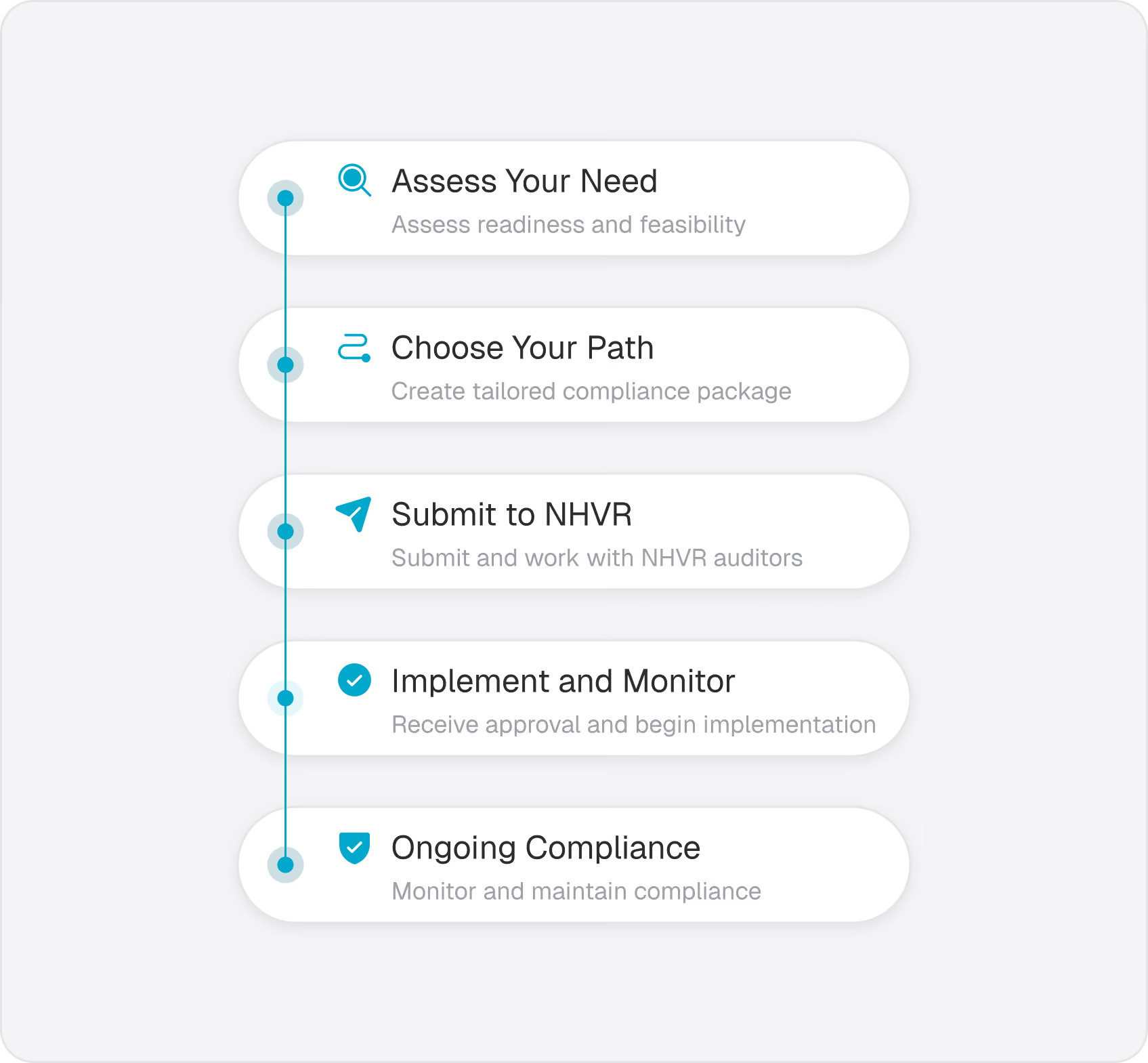
Getting Alternative Compliance Approval
Step 1: Assess Your Need
  • Do you need flexibility beyond Baseline limits?
  • Are your operations suitable for Alternative Compliance?
  • Can you implement required controls?
  • Do you have SMS capability?
Step 2: Choose Your Path
  • Review the 8 pre-defined NHVR rule sets — if one fits, select it
  • If no pre-defined rule set suits your operations, develop a bespoke application
  • For bespoke: design schedules, conduct risk assessment, score against RCSM
  • Document controls and demonstrate SMS readiness
Step 3: Submit to NHVR
  • Complete Alternative Compliance application
  • Provide supporting evidence
  • Include risk assessments and controls
  • Show consultation with drivers
Step 4: Implement and Monitor
  • Configure approved schedules in Hubfleet
  • Train drivers and schedulers
  • Monitor compliance and effectiveness
Step 5: Ongoing Compliance
  • Maintain SMS evidence
  • Review schedule effectiveness
  • Update controls based on learnings
  • Prepare for NHVR audits
What NHVR Auditors Look For
Schedule Design Evidence:
  • Operator-specific schedules documented
  • Risk assessment for each schedule type
  • Controls matched to identified risks
  • Consultation with drivers and Health and Safety Representatives (HSRs)
Application Documentation (retained for reference):
  • NHVR-approved rule set or bespoke application on file
  • Controls matched to identified risk levels
  • Safety case documentation retained (if applicable for bespoke applications)
Split Rest Controls:
  • Emergency use only (not routine scheduling)
  • Minimum rest block validation
  • Usage tracking and pattern monitoring
  • Management review of all split rest uses
Monitoring and Review:
  • KPI tracking for Alternative Compliance
  • Incident analysis related to fatigue
  • Schedule effectiveness reviews
  • Continuous improvement evidence

How Hubfleet Supports Alternative Compliance    

Schedule Management & Enforcement
Schedule Creation & Compliance Checking
  • Create work schedules and check they comply with your approved rule set
  • Validate schedules against rule set limits before assigning to drivers
  • Ensure planned schedules stay within approved parameters
Real-Time Enforcement
  • Monitors driver hours against NHVR-approved limits in real time
  • Alerts drivers and managers as limits approach
  • System blocks work beyond approved limits
  • GPS cross-checking of work diary entries
Breach & Incident Management
Detection & Response
  • Early warning alerts as rule set limits approach
  • Automatic incident creation on breach
  • Absolute outer limits always enforced
  • Breach severity classification
Non-Conformance Reports (NCRs)
  • Breaches generate NCRs for formal investigation
  • Root cause analysis and contributing factors documented
  • Corrective actions assigned and tracked to closure
  • Manager review and sign-off
  • Pattern and trend analysis over time
Extended Fatigue Hours Controls
Request Extended Fatigue Hours
  • Button available based on rule set and driver history
  • Driver selects extended work or reduced rest (split rest)
  • Incident report form completed by driver
  • Compliance manager approves or denies in real time
Usage Prevention
  • Cannot pre-schedule extended hours or split rests
  • Availability controlled by rule set and fatigue history
  • Pattern detection and flagging
  • Compliance manager review for excessive use
Audit-Ready Reporting & Evidence
Icon
SMS evidence generated automatically
Icon
Complete audit trail of all breaches and extended fatigue hours requests
Icon
Fatigue data feeds into risk register
Icon
PSOE-aligned evidence bundles for NHVR audits
Icon
All incidents, approvals, and corrective actions documented
Icon
Control effectiveness tracking

Common Questions

What's the difference between Alternative Compliance and AFM?
Alternative Compliance is HVNL's replacement for AFM. The NHVR is expected to offer 8 pre-defined rule sets that cover around 90% of current industry AFM usage — most operators will simply select a rule set from this list. Operators with unique requirements can also apply for a bespoke rule set with custom schedules within outer safety limits (max 15.5hr work, min 7hr rest). Bespoke applications must be scored against the RCSM (Risk Classification System Matrix), and split rest is restricted to emergency use only.
Do I need Alternative Compliance or is Baseline enough?
Use Baseline if you can operate within standard limits (12hr work, 7hr rest, standard work week). Consider Alternative Compliance if you need flexibility for longer work days, specialised industries, variable workloads, or operations where standard limits create impractical constraints. Most operators moving to Alternative Compliance will find that one of the 8 pre-defined NHVR rule sets covers their needs, making the transition straightforward.
What are the pre-defined rule sets?
The NHVR is expected to offer 8 pre-defined rule sets that cover around 90% of current industry AFM usage. These rule sets are designed around common industry work/rest patterns (e.g. long-haul, line-haul, mining rotations). One of the pre-defined rule sets is expected to be very similar to — if not the same as — the current BFM, making it easy for BFM operators to transition. Operators can select the rule set that best matches their operations, which simplifies the application process and may result in faster approval compared to a bespoke application. Overall, HVNL offers significantly more flexibility than the current BFM/AFM system.
How long does Alternative Compliance approval take?
Timelines vary depending on whether you choose a pre-defined or bespoke rule set. Selecting a pre-defined rule set is expected to have a faster approval process since the rule sets are already assessed by NHVR. For bespoke applications, allow 4-8 weeks for NHVR approval plus 4-6 weeks for application development (risk assessment, schedule design, control documentation). In either case, allow time for system configuration and driver training before go-live.
Can a driver ever exceed the 15.5-hour outer limit?
No. The absolute outer limits — maximum 15.5 hours work and minimum 6 hours continuous rest block (8 hours total) in a 24-hour period — are hard ceilings that cannot be exceeded under any circumstances. No rule set, pre-defined or bespoke, can allow a driver to work beyond these limits. Each individual rule set defines its own specific limits within these outer limits.
What happens if a driver approaches their rule set limits?
Hubfleet monitors driver hours in real time against their approved rule set limits. As limits approach, the system alerts both the driver and supervisor. If a rule set limit is breached (e.g., a driver on a 14-hour rule set works 14.5 hours due to unexpected delays), an incident is automatically created. The incident captures the circumstances, contributing factors, and corrective actions. Pattern analysis identifies recurring causes so operators can address systemic issues. At no point can the absolute outer limits be exceeded.
Can I still use split rest breaks?
Yes, but only for solo drivers in emergency or unforeseeable circumstances. Two-up drivers are not eligible for split rest. You cannot pre-schedule split rests or use them for routine operations. In Hubfleet, drivers tap Request Extended Fatigue Hours and select either extended work hours or reduced rest (split rest). The driver completes an incident report form, and compliance managers are notified in real time to review and approve or deny the request before the driver can proceed. At least one rest block must be 6 hours continuous, with a total of at least 8 hours rest. Hubfleet tracks all requests and flags excessive patterns for compliance manager review.
What is the RCSM?
The RCSM (Risk Classification System Matrix) is an assessment tool defined in the Ministerial Standard for Alternative Compliance Hours. When applying for Alternative Compliance, you score your proposed work schedules against the RCSM's 7 principles across 3 dimensions (work-related rest breaks, recovery breaks, and reset breaks). The NHVR uses these scores — alongside your SMS evidence — to decide whether to approve your schedules. Hubfleet doesn't perform the RCSM scoring, but once your schedules are approved, Hubfleet enforces those limits in real time and generates the ongoing compliance evidence NHVR expects.
How does Alternative Compliance affect my SMS?
Alternative Compliance is integrated into your SMS as part of fatigue risk management (Outcome Area 2: Risk Management). Your SMS must document your Alternative Compliance schedules, breach management, split rest controls, and monitoring processes. Hubfleet automatically generates SMS evidence for Alternative Compliance as part of your overall SMS documentation.
Get Started in Days, Not Months
Free guides, tools, and frameworks to start preparing for HVNL today — built by Australian compliance specialists and trusted by 500+ fleets.
Blue binder or folder with three horizontal black lines on the front cover.
HVNL Compliance Guide
What HVNL means for your fleet — explained in plain English
  • All 5 SMS outcome areas explained
  • Implementation timeline & milestones
  • Fleet preparation checklist
  • Gap assessment framework
  • Change summary from current HVNL
Read the Guide
HVNL Compliance Toolkit
Free downloadable templates to start preparing today.
  • Gap analysis template (5 outcome areas)
  • Pre-audit readiness checklist
  • SMS implementation tracker
  • PSOE evidence mapping
  • Implementation timeline template
Get the Free Toolkit
Audit Preparation Guide
The questions NHVR auditors ask — and where to find your answers.
  • Common auditor questions by outcome area
  • Direct answers showing where evidence sits in Hubfleet
  • PSOE framework explained
  • Audit-day preparation checklist
  • Real auditor scenarios
Read the Audit Guide

Navigate HVNL reforms fatigue flexibility with Confidence

Green check mark icon inside a rounded white square.
Baseline and Alternative Compliance
Support for both accreditation tiers
Green check mark icon inside a rounded white square.
All 8 rule sets ready
Every pre-defined NHVR rule set implemented and ready for operators, plus bespoke schedule configuration
Green check mark icon inside a rounded white square.
Real-time schedule enforcement
Approved limits monitored and enforced via EWD
Green check mark icon inside a rounded white square.
Rule set breach management
Incident workflows with root cause analysis and corrective actions
Green check mark icon inside a rounded white square.
Split rest controls
Solo driver emergency use tracking and validation
Green check mark icon inside a rounded white square.
Complete audit evidence
All Alternative Compliance requirements documented
Green check mark icon inside a rounded white square.
Expert support
Guidance on applications and NHVR compliance

Related Resources

Icon of a closed book with a blue spine and three horizontal lines on the cover representing text.
Fatigue Management Best Practices
Practical tips for managing driver fatigue
View Resources
Icon of a blue ascending bar chart with three bars increasing in height from left to right and an upward trending arrow above.
HVNL Reform Implementation Roadmap
Step-by-step guide to HVNL reforms transition
View Resources

Ready for the HVNL reforms' flexible fatigue management? Implement Alternative Compliance with Hubfleet.

Stylized blue paper airplane icon with shadow on transparent background.
Start Free Trial
Recommended for most fleets
Best if you're ready to get drivers logging now and explore Hubfleet at your own pace.
Icon
Full platform access — every feature, no limits
Icon
Drivers can start on EWD today
Icon
Real EWD, SMS, and compliance reporting from day one
Icon
No upfront costs · No lock-in contract
Start Free Trial
Icon of a calendar with blue top binder and dark gray date display area.
Book your Demo
Best for larger fleets or complex setups
Best if you've got specific integration questions, multiple sites, or want a tailored walkthrough first.
Icon
Tailored to your fleet and use case
Icon
30 minutes with a Hubfleet specialist
Icon
See the platform mapped against your fleet's compliance obligations
Icon
Get HVNL and SMS questions answered live
Book your 30-Minute Demo
Want to see plans first?
Icon
500+ Australian operators
Icon
NHVR approved
Icon
Free trial
Icon
Australian-based support