

PSOE Evidence Framework Guide
The definitive guide to understanding how NHVR auditors assess your Safety Management System under HVNL reforms — and exactly what evidence you need to demonstrate compliance across all 5 outcome areas
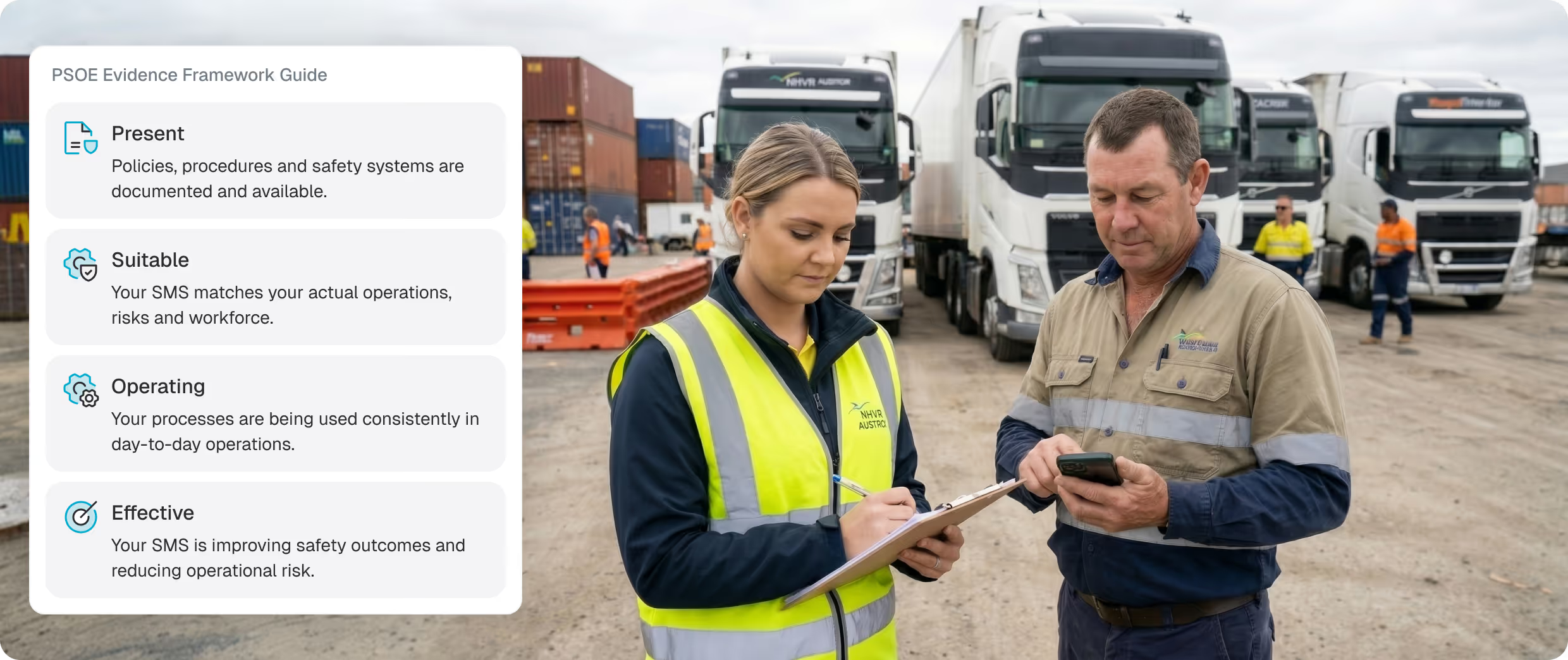
What is the PSOE Framework?
Under HVNL reforms, the NHVR no longer uses simple yes/no compliance checklists. Instead, auditors assess your Safety Management System against four progressive evidence criteria known as PSOE:
Criteria
Question the Auditor Asks
What It Means
Present
Does the SMS component exist?
Documented policies, procedures, systems, and tools are in place. You have the "what" — the paperwork, the platform, the processes written down.
Suitable
Is it appropriate for your operations?
The SMS is tailored to your actual risks, fleet size, operating environment, and workforce. A generic template downloaded from the internet is Present but not Suitable.
Operating
Is it actually being used?
6+ months of timestamped, verifiable records proving the SMS is followed in daily operations. This is where most operators fail — having procedures that exist on paper but aren't consistently applied.
Defect Management
Is it improving safety outcomes?
6–12 months of trend data showing the SMS is actually reducing risk. Breach rates declining, incidents decreasing, near-miss reporting increasing, corrective actions closing on time.
Critical Understanding:
PSOE is not a pass/fail checklist — it's a progressive assessment framework. Auditors assess where you sit on the PSOE spectrum for each of the 5 SMS outcome areas. You need to demonstrate all four criteria (Present, Suitable, Operating, Effective) to achieve full compliance and secure Alternative Compliance accreditation.
Why PSOE Matters for Your Business
The Shift from Prescriptive to Outcome-Based Compliance
Under the current HVNL, compliance is largely prescriptive: follow specific rules, keep specific records, tick specific boxes. HVNL reforms fundamentally changes this approach.
Aspect
Current HVNL
HVNL reforms (PSOE-Based)
Audit approach
Checklist — do you have X? Yes/No
Evidence-based — show me X is Present, Suitable, Operating, and Effective
What's assessed
Individual compliance items
Entire SMS across 5 outcome areas
Evidence depth
Point-in-time records
6–12 months of operational evidence with trend data
"Good enough"
Having the right paperwork
Proving the paperwork reflects reality and is improving outcomes
Failure mode
Missing a specific document
Having documents that aren't followed, or systems that don't improve safety
What This Means in Practice
Example: Pre-Start Inspections
PSOE Level
What the Auditor Looks For
Present
Written pre-start inspection procedure exists. Checklists available for each vehicle type.
Suitable
Checklists are tailored to your specific vehicles and operating conditions (not generic templates). Critical items relevant to your operations are included.
Operating
6+ months of completed inspection records with timestamps and GPS verification. Completion rate >95%. Defects identified and actioned.
Effective
Defect detection rates stable or improving. Critical defects caught before failure. Mean time to repair trending downward. No incidents attributable to missed inspections.
PSOE Across the 5 SMS Outcome Areas
HVNL reforms requires your SMS to cover 5 mandatory outcome areas. Each must independently demonstrate Present, Suitable, Operating, and Effective. Here's what that looks like:
Outcome Area 1
Leadership & Commitment
Purpose:
Senior management actively leads safety and allocates resources for compliance systems.
Present — What must exist
- Written safety policy signed by senior management stating commitment to HVNL reforms compliance
- Organisational chart showing safety responsibilities
- Budget allocation for SMS (technology, training, maintenance, safety equipment)
- Scheduled management review of SMS performance (at least quarterly)
Suitable — How it must be tailored
- Safety policy references your specific operations, fleet type, and operating environment
- Accountabilities match your actual organisational structure (not a generic corporate template)
- Budget is proportionate to your fleet size and risk profile
- Management review agenda covers issues relevant to your operations
- Safety objectives are specific and measurable for your business
Operating — Proof it's being followed
- Management meeting minutes showing safety discussed as standing agenda item (6+ months of records)
- Resource allocation decisions documented (approved purchases, training investments, technology deployments)
- Evidence of management responding to safety issues (incident reviews, corrective action approvals)
- Annual management review of SMS completed with documented outcomes and improvement actions
- Safety policy reviewed and re-signed within past 12 months
Effective — Proof it's improving outcomes
- Management actions from reviews are implemented and verified (track action completion rate — target >90%)
- Accountabilities match your actual organisational structure (not a generic corporate template)
- Worker perception of management commitment is positive (feedback, surveys, reporting rates increasing)
- Management review findings drive measurable system improvements over 6–12 months
Outcome Area 2
Risk Management
Purpose:
Systematic identification of transport safety risks, assessment of likelihood and consequence, and implementation of controls.
Present — What must exist
- Risk register covering all transport and safety-related activities
- Risk assessment methodology (likelihood × consequence matrix)
- Hazard identification process (how risks are found — driver reports, incident investigations, seasonal/project reviews)
- Control hierarchy applied to each identified risk
- Documented process for reviewing and updating risk assessments
Suitable — How it must be tailored
- Risk register addresses hazards specific to your industry and operations (not a generic template)
- Risk assessments consider your actual operating conditions — seasonal peaks, remote environments, harsh conditions, workforce profile
- Controls are practical and implementable for your fleet size and structure
- Risk methodology is proportionate (small operator doesn't need enterprise risk framework, but must be systematic)
- Review triggers are appropriate (e.g., after incidents, before peak seasons, when operations change)
Operating — Proof it's being followed
- Risk register addresses hazards specific to your industry and operations (not a generic template)
- Risk assessments consider your actual operating conditions — seasonal peaks, remote environments, harsh conditions, workforce profile
- Controls are practical and implementable for your fleet size and structure
- Risk methodology is proportionate (small operator doesn't need enterprise risk framework, but must be systematic)
- Review triggers are appropriate (e.g., after incidents, before peak seasons, when operations change)
Effective — Proof it's improving outcomes
- Control effectiveness reviews show controls are reducing risk (e.g., fatigue controls → fewer breaches)
- Incident root causes link back to risk register (risks were anticipated, controls were in place)
- Risk profile trending downward over 6–12 months (fewer high/extreme risks, controls moving risks to lower categories)
- Near-miss reporting increasing (indicates workers engaged in hazard identification, not that safety is declining)
- Continuous improvement actions from risk reviews are completed and verified
Outcome Area 3
People
Purpose:
Ensuring all people involved in transport operations are competent, trained, fit-for-duty, and supported to work safely.
Present — What must exist
- Driver licensing and medical fitness records management system
- Training program covering induction, EWD operation, pre-start inspections, load restraint, emergency procedures, and role-specific skills
- Fitness-for-duty assessment process (every shift, covering all impairments — fatigue, illness, injury, medication, psychological state)
- Fatigue management monitoring system (work/rest compliance tracking, breach investigation process)
- Competency verification process for specialised roles
Suitable — How it must be tailored
- Training content addresses your specific operations, vehicles, routes, and risks
- Fitness-for-duty questions are relevant to your operating environment (e.g., heat stress for outdoor operations, dust exposure for construction/agriculture)
- Competency framework matches actual job requirements (not over-engineered or under-specified)
- Seasonal/temporary workforce management processes exist if you use casual or contract drivers
- Training delivery methods suit your workforce (mobile app for remote workers, in-person for hands-on skills)
Operating — Proof it's being followed
- Training records complete for all drivers and operators (6+ months, no gaps)
- Fitness-for-duty assessments completed every shift with timestamped records
- Medical certificates current for all drivers (expiry tracking, no lapsed certificates)
- Fatigue breaches investigated with documented outcomes and corrective actions
- Competency sign-offs completed before workers operate independently
- Induction records for all new starters (permanent, seasonal, contractor)
Effective — Proof it's improving outcomes
- Fitness-for-duty intervention rate monitored for patterns (very low rates may indicate workers are not reporting honestly; very high rates may indicate systemic issues requiring attention)
- Fatigue breach rate declining over time (indicates training, roster design, and monitoring are working)
- Training linked to reduced incident rates (e.g., load restraint training → fewer load shift incidents)
- Worker competency improving (fewer errors, faster time to proficiency for new starters)
- Fitness-for-duty concerns receive appropriate follow-up (rest, medical attention, shift reassignment — documented)
Outcome Area 4
Assurance, Monitoring and Improvement
Purpose:
Systematic monitoring, checking, and auditing to verify that SMS controls are actually being followed and are effective.
Present — What must exist
- Compliance monitoring system (dashboards, reports, alert mechanisms)
- Internal audit/review schedule (monthly compliance reports, quarterly management reviews, annual SMS audits)
- Corrective Action Register (CAR) for tracking identified issues to resolution
- Incident and near-miss investigation process
- Continuous improvement framework (how findings lead to system changes)
Suitable — How it must be tailored
- Monitoring frequency matches your risk profile (daily during peak operations, weekly during normal operations)
- KPIs are relevant to your operations (industry-specific metrics, not generic)
- Audit scope covers your actual activities (transport, equipment, workforce management)
- CAR categories and severity ratings appropriate for your operation size
- Investigation methodology proportionate (small incidents need brief review, serious incidents need formal root cause analysis)
Operating — Proof it's being followed
- Compliance dashboards reviewed regularly with documented evidence (6+ months of review records)
- Internal audits completed on schedule (audit reports available)
- CAR items tracked to closure with documented verification of effectiveness
- Incidents investigated within defined timeframes (e.g., serious incidents within 48 hours, minor within 7 days)
- Management reviews conducted quarterly with minutes and action items
Effective — Proof it's improving outcomes
- CAR closure rate >90% (corrective actions completed on time)
- Audit findings declining over time (fewer non-conformances at each review cycle)
- Incident investigation recommendations implemented and verified (not just identified)
- KPI trends improving over 6–12 months (breach rates down, completion rates up, incidents declining)
- System changes resulting from reviews are documented and measurable
Outcome Area 5
Safety Systems
Purpose:
Documented systems, processes, and procedures covering all operational safety aspects — fatigue management, vehicle safety and maintenance, mass and loading, fitness-for-duty, incident management, and emergency response.
Present — What must exist
- Policy and procedure library covering: fatigue management, fitness-for-duty, pre-start inspections, defect management, mass management, load restraint, incident reporting, emergency response, and any industry-specific procedures
- Driver/operator acknowledgments of policies and procedures
- Digital or systematic pre-start inspection system with records
- Defect management workflow (report → assess → repair → verify)
- Maintenance schedules and service records system
- Incident reporting and investigation system
- Emergency response procedures
Suitable — How it must be tailored
- Procedures address your specific vehicle types, equipment, and operating conditions
- Pre-start checklists tailored to each vehicle/equipment type in your fleet
- Maintenance intervals adjusted for your actual operating environment (harsh conditions may require shorter intervals)
- Emergency procedures account for your operating locations (remote areas, urban sites, interstate routes)
- Mass management procedures address your specific load types and variability
- Policies written in language accessible to your workforce
Operating — Proof it's being followed
- Pre-start inspections completed consistently (>95% completion rate, 6+ months of records)
- Defects reported, assessed, and repaired with documented workflow (no vehicles operating with unresolved critical defects)
- Maintenance completed on schedule (overdue services tracked and actioned)
- Policies reviewed and acknowledged by all current workers
- Incident reports filed for all reportable events with investigation completed
- Emergency procedures tested or exercised at least annually
Effective — Proof it's improving outcomes
- Pre-start inspections catching defects before failures (defect detection vs breakdown rate)
- Maintenance system preventing unplanned breakdowns (scheduled vs unscheduled maintenance ratio improving)
- Vehicle defect rate stable or declining over time
- No incidents attributable to procedure gaps or non-compliance
- Policy reviews result in updates that address identified gaps
- Emergency response tested and improvements implemented from exercises
Building Your PSOE Evidence: A Practical Timeline
PSOE evidence isn't something you can create overnight. The "Operating" and "Effective" criteria require real operational data collected over months. Here's the realistic timeline:
Phase 1: Present & Suitable (Weeks 1–8)
Goal: Get your SMS documented and configured for your operations.
Thank you! Your submission has been received!
Oops! Something went wrong while submitting the form.
At 8 weeks
Your SMS is Present (everything exists) and Suitable (tailored to your operations). But you have zero Operating or Effective evidence yet.
Phase 2: Operating Evidence (Months 2–8)
Goal: Build 6+ months of timestamped records proving the SMS is followed daily.
Thank you! Your submission has been received!
Oops! Something went wrong while submitting the form.
At 8 weeks
Your SMS is Operating — you have 6+ months of consistent, timestamped evidence showing the system is followed in daily operations.
Phase 3: Effective Evidence (Months 6–12)
Goal: Demonstrate 6–12 months of trend data showing the SMS is improving safety outcomes.
Thank you! Your submission has been received!
Oops! Something went wrong while submitting the form.
At 12 months
Your SMS is Effective — you can demonstrate to auditors that your system isn't just running, it's working and improving safety outcomes.
Common PSOE Pitfalls (and How to Avoid Them)
Pitfall
The problem
The auditor test
The fix
Paper SMS
Policies and procedures exist in a folder but aren't followed in practice.
"Show me 6 months of records proving this procedure is used."
Use a digital SMS platform that captures timestamped evidence automatically. If drivers complete pre-starts on the app, the evidence is created as a by-product of daily operations — not as extra paperwork.
Generic Templates
Downloaded a template SMS from the internet and put your company name on it.
"How does this risk assessment relate to your specific operations?"
Start with templates if helpful, but customise every element. Your risk register must reflect your hazards, your vehicles, your routes, your workforce. Auditors can immediately spot a generic template.
No Trend Data
You have 12 months of records, but you've never analysed them for trends.
"Show me how safety outcomes have improved since implementing your SMS."
Generate monthly or quarterly trend reports. Track KPIs over time. Even if performance is already good, show stability. If performance improved, show the improvement and link it to specific actions taken.
Corrective Actions Not Closed
Incidents are investigated and corrective actions identified, but never completed.
"Show me your Corrective Action Register. What percentage are closed on time?"
Track every corrective action with owner, due date, and verification. Target >90% on-time closure. Review overdue items in management meetings.
Fitness-for-Duty = Fatigue Only
Your fitness-for-duty process only asks about fatigue/sleep.
"How do you assess medication, illness, injury, and psychological fitness?"
HVNL reforms expands fitness-for-duty to cover all impairments. Your daily assessment must include fatigue, illness, injury, medication, psychological state, and alcohol/drugs.
Starting Too Late
Waiting until HVNL reforms commences to begin implementation.
"How long has your SMS been operating? Show me 6 months of evidence."
Start building your evidence as early as possible. HVNL reforms is expected mid-2026. You need 6+ months of Operating evidence before applying for Alternative Compliance. Starting after commencement means operating under Baseline Compliance (12hr limit) while building evidence — which may be operationally infeasible.
PSOE Evidence Checklist
Use this checklist to assess your readiness across all 5 outcome areas:
Leadership & Commitment
Thank you! Your submission has been received!
Oops! Something went wrong while submitting the form.
Risk Management
Thank you! Your submission has been received!
Oops! Something went wrong while submitting the form.
People
Thank you! Your submission has been received!
Oops! Something went wrong while submitting the form.
Assurance, Monitoring and Improvement
Thank you! Your submission has been received!
Oops! Something went wrong while submitting the form.
Safety Systems
Thank you! Your submission has been received!
Oops! Something went wrong while submitting the form.
How Hubfleet Automates PSOE Evidence Collection
The biggest challenge with PSOE isn't understanding what's required — it's collecting 6–12 months of consistent evidence without drowning in admin. Hubfleet solves this by making evidence collection a by-product of daily operations:
PSOE Requirement
Manual Approach
Hubfleet Approach
Pre-start records
Paper inspection books, manually filed, often incomplete
Digital checklists on mobile app — timestamped, GPS-verified, photo-capable, auto-stored
Fitness-for-duty records
Paper forms or verbal declarations, no audit trail
Daily digital assessment before each shift — recorded, flagged, escalated automatically
EWD compliance
Paper work diaries with manual checking
Digital EWD with real-time breach forecasting, GPS cross-check, automated alerts
Incident records
Paper forms, email chains, spreadsheet tracking
Digital incident reporting with investigation workflows, root cause analysis, CAR integration
Training records
Spreadsheets, filing cabinets, manual expiry tracking
Digital training register with auto-expiry alerts, competency sign-offs, induction tracking
Management reviews
Unstructured meetings, ad hoc reporting
Automated KPI dashboards, scheduled review workflows, documented action tracking
Trend analysis
Manual spreadsheet analysis (if done at all)
Automated trend reports — fatigue breaches, pre-start completion, incident rates, CAR closure — generated monthly
Audit export
Weeks of gathering records from multiple sources
Streamlined export — PSOE evidence compiled in a fraction of the time
The Hubfleet Difference:
Operators using Hubfleet report reducing audit preparation from weeks to days. The evidence is already there — captured automatically as part of daily operations.
Industry-Specific PSOE Guidance
While the PSOE framework applies universally, how you demonstrate each criterion depends on your industry. See our industry-specific guides for tailored PSOE examples, risk registers, and evidence strategies:
- Agriculture & Livestock Transport — Seasonal peaks, animal welfare conflicts, remote operations, multi-role workers
- Transport & Logistics — Long-haul fatigue, multi-state compliance, driver-away-from-base challenges
- Construction & Heavy Equipment — Dual workforce (drivers + operators), harsh conditions, multi-site coordination
- Bus & Coach Operations — Passenger safety obligations, fixed route scheduling, driver welfare
- Waste & Recycling — Repetitive routes, early morning fatigue, public interaction risks
- Mining & Resources — Remote operations, FIFO fatigue, harsh environments, heavy vehicle coordination
- Western Australia & Cross-Border — Dual jurisdiction, WA-specific fatigue rules, remote operations
Industry-Specific PSOE Guidance
While the PSOE framework applies universally, how you demonstrate each criterion depends on your industry. See our industry-specific guides for tailored PSOE examples, risk registers, and evidence strategies:


Get Started in Days, Not Months
Free guides, tools, and frameworks to start preparing for HVNL today — built by Australian compliance specialists and trusted by 500+ fleets.

HVNL Compliance Guide
What HVNL means for your fleet — explained in plain English
- All 5 SMS outcome areas explained
- Implementation timeline & milestones
- Fleet preparation checklist
- Gap assessment framework
- Change summary from current HVNL
Read the Guide

HVNL Compliance Toolkit
Free downloadable templates to start preparing today.
- Gap analysis template (5 outcome areas)
- Pre-audit readiness checklist
- SMS implementation tracker
- PSOE evidence mapping
- Implementation timeline template
Get the Free Toolkit

Audit Preparation Guide
The questions NHVR auditors ask — and where to find your answers.
- Common auditor questions by outcome area
- Direct answers showing where evidence sits in Hubfleet
- PSOE framework explained
- Audit-day preparation checklist
- Real auditor scenarios
Read the Audit Guide

Common Questions
What does PSOE stand for?
PSOE stands for Present, Suitable, Operating, and Effective. These are the four progressive evidence criteria NHVR auditors use to assess your Safety Management System under HVNL reforms. Each of the 5 SMS outcome areas must independently demonstrate all four criteria.
How long does it take to build enough PSOE evidence?
Realistically, 8–12 months. The first 8 weeks are spent setting up your SMS (Present and Suitable). You then need 6+ months of consistent operational records to demonstrate Operating, and 6–12 months of trend data showing improvement to demonstrate Effective. These timelines cannot be compressed — auditors need to see real evidence collected over time.
Can I use my existing NHVAS accreditation as PSOE evidence?
Your existing NHVAS records can contribute to your evidence base, but HVNL reforms requires a broader SMS covering all 5 outcome areas — not just the modules you were previously accredited under. You will likely need to expand your documentation and evidence collection to cover areas like leadership and commitment, risk management, and assurance that may not have been formally assessed before.
What happens if I only meet Present and Suitable but not Operating?
You won't qualify for Alternative Compliance accreditation. Without Operating evidence (6+ months of records showing the SMS is actively followed), you will remain under Baseline Compliance with a 12-hour work limit. This is why starting early is critical — you need months of real operational data before you can apply.
Do I need to demonstrate Effective for initial accreditation?
For entry-level NHVR audits, auditors primarily assess whether your SMS is Present and Suitable. Operating and Effective evidence becomes increasingly important for subsequent audits and for maintaining Alternative Compliance accreditation over time. However, building towards Effective from day one puts you in the strongest position.
How does Hubfleet help with PSOE evidence collection?
Hubfleet captures PSOE evidence automatically as a by-product of daily operations. When drivers complete EWD entries, pre-start inspections, fitness-for-duty assessments, and incident reports through the platform, timestamped and GPS-verified records are stored automatically. Compliance dashboards, trend reports, and audit-ready exports mean you spend less time on admin and more time running your business.
HVNL reforms Expected Commencement: Mid-2026
PSOE "Operating" evidence requires 6+ months of real operational data. "Effective" evidence requires 6–12 months of trend data. These timelines cannot be compressed.
Start building your evidence now. Operators who begin in early 2026 will have a full operating season of evidence before HVNL reforms commencement. Operators who wait until after commencement will be playing catch-up under the new framework.

Start Free Trial
Recommended for most fleets
Best if you're ready to get drivers logging now and explore Hubfleet at your own pace.

Full platform access — every feature, no limits
Drivers can start on EWD today
Real EWD, SMS, and compliance reporting from day one
No upfront costs · No lock-in contract
Start Free Trial

Book your Demo
Best for larger fleets or complex setups
Best if you've got specific integration questions, multiple sites, or want a tailored walkthrough first.
Tailored to your fleet and use case
30 minutes with a Hubfleet specialist
See the platform mapped against your fleet's compliance obligations
Get HVNL and SMS questions answered live
Book your 30-Minute Demo
Want to see plans first?

500+ Australian operators
NHVR approved
Free trial
Australian-based support