

Mass Management & Permit Compliance for HVNL reforms
A comprehensive guide for heavy vehicle operators navigating mass compliance requirements under Australia's updated Heavy Vehicle National Law
Mass management has always been a cornerstone of heavy vehicle compliance in Australia, but HVNL reforms fundamentally changes how operators must approach it. Where the current HVNL prescribes simple mass limits and penalties for breaches, HVNL reforms embeds mass management into the mandatory Safety Management System (SMS) framework, requiring operators to demonstrate systematic, proactive control of mass risks across their operations.
This guide explains what HVNL reforms mass management requirements mean in practice, how they integrate with the broader SMS framework, and how to implement systematic mass controls that satisfy the new Present, Suitable, Operating, Effective (PSOE) audit standard.
1. Legislative Context: Current HVNL vs. HVNL reforms
- Fixed mass limits based on vehicle configuration (GML, CML, HML, PBS, permits)
- Roadside weighing and inspections
- Infringement penalties for detected breaches
- Court prosecution for serious breaches (>120% of limit)
- Minor risk breach (<105%): Up to $5,300
- Substantial risk breach (105-120%): Up to $8,000
- Severe risk breach (>120%): Up to $13,310
- Companies face significantly higher penalties for repeat offences
- Reactive: Only catches breaches when vehicles are intercepted
- No requirement for systematic mass management processes
- Limited visibility into loading practices and trends
- Difficult to prove proactive mass control
- 17-ton tandem axle group (previously 16.5t)
- 21-ton tri-axle group (previously 20t)
- Present: Documented mass policies, procedures, and controls
- Suitable: Systems appropriate for your vehicle types, routes, and loading operations
- Operating: Evidence the system is actively used day-to-day
- Effective: Demonstrated through trend data showing mass control is working
2. Mass Management Across the 5 SMS Outcome Areas
- Senior management acknowledges mass management as a critical safety priority
- Mass compliance included in organisational safety policy
- Resources allocated for mass control systems (weighing equipment, training, technology)
- Mass KPIs tracked and reviewed by leadership regularly
- Management demonstrates commitment through investment in weight gauges, training, and digital systems
- Safety policy explicitly mentions mass management
- Board/management meeting minutes showing mass KPI reviews
- Budget allocation for weight gauges, weighbridges, or digital mass tracking
- Management sign-off on mass management procedures
- Mass-related hazards identified (overloading, axle imbalance, load shift, infrastructure damage)
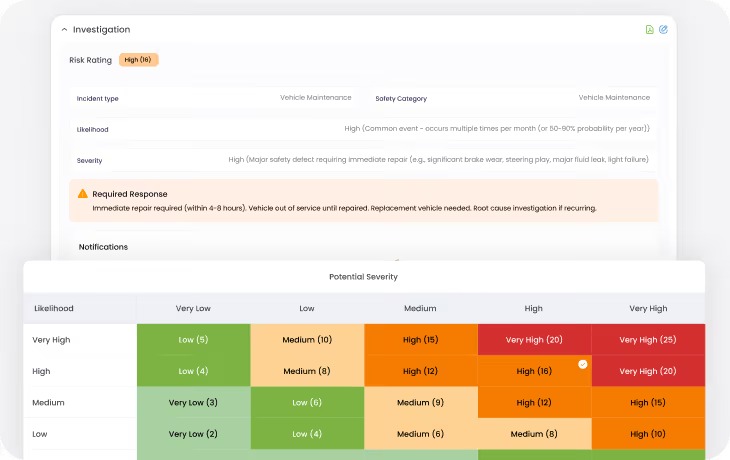
- Mass risks assessed using your risk matrix (likelihood × severity)
- Controls documented for each mass risk
- Incidents involving mass breaches or mass-related safety events investigated
- Risk register updated based on mass trends
- Mass hazards documented in risk register
- Risk assessments completed for each mass hazard
- Controls assigned to each risk (e.g., "all loads verified on weighbridge")
- Incident investigation reports for mass breaches showing root cause and corrective actions
- Trend analysis showing reduction in mass-related incidents over time
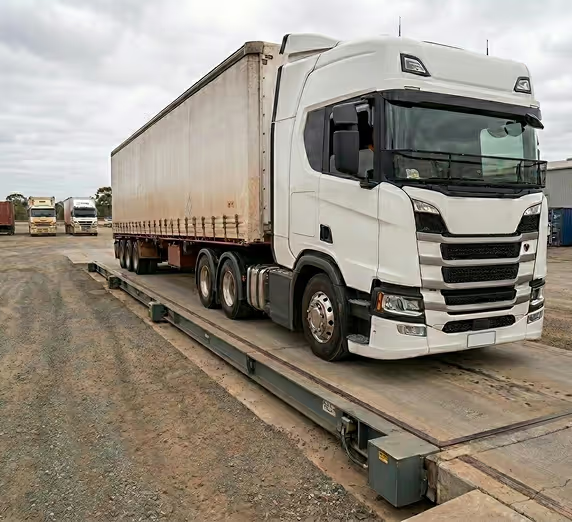
- Weighbridge verification before dispatch: Effective if 100% of loads checked before leaving depot
- Driver mass training: Effective if drivers can correctly identify vehicle limits and reading weight gauges
- Customer weight declarations: Review for accuracy; flag and address discrepancies
- Drivers trained on mass limits specific to their vehicle and configuration
- Loaders trained on mass distribution and axle group limits
- Schedulers and planners aware of mass constraints for route and load planning
- Competency assessments confirm understanding of mass requirements
- Training records maintained with expiry and renewal tracking
- Tare weight of each vehicle combination in the fleet
- GVM (Gross Vehicle Mass) and ATM (Aggregate Trailer Mass) for their vehicles
- Axle group limits (steer, drive, tandem, tri-axle) for the mass scheme they operate under (GML, CML, HML, PBS, permit)
- How to read and interpret on-board weight gauges
- How to verify load weight using weighbridges
- Permit conditions and route restrictions for oversize/over-mass loads
- What to do if load is found to be over-mass (report, off-load, reposition)
- Consequences of mass breaches for driver, company, and public safety
- Mass limits and axle distribution requirements
- How to load and position freight to balance axle groups
- Use of load plans and weight calculations
- Container weight declarations (VGM compliance)
- Load restraint impact on mass distribution
- Vehicle mass capacities and route restrictions
- Permit requirements for over-mass loads
- Load planning to avoid exceeding mass limits
- Customer site weighbridge availability
- Integration of mass data into scheduling decisions
- Training matrix showing mass training requirements for each role
- Training records with completion dates and signatures
- Competency assessments (written tests, practical observations)
- Refresher training scheduled and completed
- Driver induction includes mass management module
- KPIs defined for mass compliance performance
- Mass data collected systematically (weighbridge records, gauge readings, breach data)
- Internal audits verify mass management procedures are being followed
- Corrective actions raised for mass breaches or procedural non-compliance
- Management reviews mass performance data and trends
- Continuous improvement: use data to refine loading, scheduling, and mass controls
- Are drivers checking weight gauges before departure?
- Are weighbridge dockets collected and filed for each trip?
- Are load plans completed and accurate?
- Do vehicles have current gauge calibration certificates?
- Are permits current and carried in vehicles?
- Are mass training records up to date?
- Are mass breaches investigated with root cause analysis?
- Is management reviewing mass KPIs at scheduled intervals?
- KPI dashboard showing monthly mass performance trends
- Internal audit reports covering mass management procedures
- Corrective Action Register showing mass-related actions with closure evidence
- Management review minutes showing discussion of mass KPIs and improvement decisions
- Trend data demonstrating improvement in mass compliance over time
- Downward trend in mass breach rate over 6-12 months
- High weighbridge verification rate (approaching 100%)
- Reduction in repeat breaches at specific loading sites
- Positive feedback from drivers on ease of compliance
- Zero or minimal infringement notices for mass breaches
- Mass management policy documented
- Mass procedures covering loading, weighing, verification, permit management
- Permit register maintained with current permits
- Document management system for mass records (weighbridge dockets, permits, calibration certificates)
- Integration of mass data into scheduling and dispatch systems
- Emergency procedures for over-mass situations
- Pre-Loading:
- Scheduler creates load plan showing expected gross and axle masses
- Load plan sent to driver and loader
- Driver confirms vehicle tare weight and mass limits
- Loading:
- Loader follows load plan
- Load positioned to distribute mass evenly across axle groups
- Load secured with appropriate restraint
- Weighing:
- Vehicle driven to weighbridge (on-site or nearest certified facility)
- Gross mass and axle group masses recorded
- Weighbridge docket printed and retained
- Verification:
- Driver compares weighbridge result to mass limits
- If within limits: Proceed with dispatch
- If over limits: Follow over-mass procedure (see below)
- Record weighbridge result in digital system or trip sheet
- Dispatch:
- Driver carries weighbridge docket in vehicle
- Driver declares mass compliance (e.g., via app or signed declaration)
- Load approved for dispatch
- Immediate Action:
- Do not depart with over-mass load
- Notify supervisor/dispatcher immediately
- Determine extent of breach (which axle group, by how much)
- Corrective Action:
- Option 1: Off-load excess freight to bring within limits
- Option 2: Reposition load to balance axle groups
- Option 3: Transfer load to larger vehicle or split into multiple loads
- Option 4: Obtain appropriate permit if time and route allow
- Re-Weigh:
- After corrective action, return to weighbridge
- Confirm vehicle is now within limits
- Obtain new weighbridge docket
- Documentation:
- Record incident in digital system or incident register
- Note: Customer site, load type, initial mass, corrective action taken
- Supervisor reviews and raises CAR for investigation
- Investigation:
- Root cause analysis: Why was load over-mass? (inaccurate load plan, gauge malfunction, customer error, driver error)
- Corrective action: Address root cause to prevent recurrence
- Trend review: Is this a repeat issue at this customer/site?
- Maintain digital or physical permit register
- Track permit expiry dates
- Assign permits to specific vehicles and loads
- Ensure drivers carry permit in vehicle when operating under permit conditions
- Brief drivers on permit conditions (route, time restrictions, escort requirements)
- Record each trip operating under permit
- Renew permits before expiry
- Mass management policy and procedures documented and accessible
- Permit register current and accurate
- Weighbridge records filed systematically with complete data
- Document retention schedule followed (3-year minimum for mass records)
- Version control for procedure updates
- Staff acknowledgement that they have read and understood procedures
3. Mass Limits and Vehicle Classification
- Rigid truck: L: 12.5m, W: 2.5m, H: 4.3m, M: 31t
- Prime mover and trailer (semi-trailer): L: 19m, W: 2.5m, H: 4.3m, M: 42.5t
- Rigid truck and trailer: L: 19m, W: 2.5m, H: 4.3m, M: 42.5t
- B-double: L: 19m, W: 2.5m, H: 4.3m, M: 42.5t
- GML (General Mass Limits): Standard limits for all heavy vehicles. Under HVNL reforms, GML increases to 17t tandem / 21t tri-axle.
- CML (Concessional Mass Limits): Previously required NHVAS Mass Management Accreditation. HVNL reforms aligns GML with CML, reducing need for separate CML accreditation for many operators.
- Route restrictions
- Time-of-day restrictions
- Escort requirements
- Speed limits
- Bridge and infrastructure restrictions
- Indivisible loads exceeding mass or dimension limits (machinery, prefab buildings, transformers)
- Oversize agricultural equipment
- Heavy construction equipment
- Abnormal loads requiring route assessment
4. Weighing and Verification Requirements
- Stationary weighbridge at depot, customer site, or public facility
- Provides gross mass and (if equipped) individual axle group masses
- Weighbridge docket is primary evidence of mass compliance
- Best practice: Weigh every load before dispatch for over-GML operations
- Air suspension gauges or electronic load cells
- Provide real-time weight indication
- Must be calibrated regularly (every 6-12 months recommended)
- Spot-check gauge accuracy against certified weighbridge periodically
- Useful for in-transit monitoring and detecting load shift
- Not a substitute for weighbridge verification in high-risk operations
- Portable scales for weighing individual axles
- Useful for field verification or remote sites
- Requires level surface and careful positioning
- Must be calibrated and certified
- Calculate expected mass based on:
- Known tare weight of vehicle
- Known weight of freight (from shipping documents, supplier declarations)
- Load distribution based on positioning
- Limitation: Relies on accurate input data; does not account for moisture, packaging variance, or loading errors
- Should be verified with weighbridge or gauges, not used as sole verification method
- Weigh 100% of loads on certified weighbridge before dispatch
- Maintain weighbridge on-site or establish relationship with nearby certified facility
- Record every weighbridge result in digital system
- Train drivers to interpret weighbridge results and compare to vehicle limits
- Weigh all over-GML loads on certified weighbridge
- Use calibrated on-board gauges for loads expected to be within GML
- Spot-check gauge accuracy against weighbridge monthly
- Record all weighbridge results and gauge readings
- Use calibrated on-board gauges as primary verification
- Periodic weighbridge verification (e.g., monthly or per vehicle)
- Load plans for predictable freight
- Immediate weighbridge verification if gauge indicates load is close to limits
- Schedule calibration every 6-12 months or per manufacturer recommendation
- Use certified calibration service
- Maintain calibration certificates for each vehicle
- Mark next calibration due date on vehicle or in digital system
- Do not rely on gauges outside calibration period
- Verify container weight declaration (Verified Gross Mass - VGM) against vehicle limits before loading
- Check container VGM plate or shipping documentation
- Confirm total weight (vehicle tare + container VGM) is within limits
- Beware of multiple containers: ensure axle distribution is considered
- Date and time
- Vehicle registration or fleet number
- Gross vehicle mass
- Axle group masses (if available)
- Load description
- Origin and destination
- Weighbridge location
- Weighbridge docket number or photo of docket
- Driver name and declaration of compliance
- Digital preferred: Easier to search, trend, and produce for audits
- Digital systems can link weighbridge data to specific trips, vehicles, and drivers
- Photo capture of weighbridge dockets via mobile app ensures no lost paperwork
- Automatic flagging of loads approaching or exceeding limits
- Paper acceptable: If systematically filed, retained for 3 years, and readily accessible for audit
5. Permit Compliance
- Allow vehicle to exceed standard GML for specific indivisible loads
- Specify maximum gross mass and axle group masses
- May require route approval and infrastructure assessment
- Allow over-length, over-width, or over-height loads
- Often combined with mass permits for large indivisible loads
- Cover both mass and dimension exceedances
- Common for construction, mining, and agricultural equipment transport
- Route restrictions: Specific approved roads only; diversions prohibited
- Time restrictions: No travel during peak hours or weekends
- Speed limits: Reduced speed (e.g., 80 km/h maximum)
- Escort requirements: Pilot vehicles required for oversize loads
- Notification requirements: Notify road authority or police before travel
- Infrastructure protection: Avoid certain bridges, roundabouts, or weight-restricted roads
- Validity period: Single trip or time-limited (e.g., 30 days)
- Operating outside permit conditions is a serious offence
- Penalties can exceed $20,000 for corporations
- Load may be impounded until compliant
- Repeat breaches can result in permit refusal for future applications
- Permit Register:
- Permit number
- Vehicle(s) covered
- Mass and dimension limits
- Route details
- Conditions
- Issue date and expiry date
- Status (current, expired, cancelled)
- Permit Distribution:
- Original permit carried in vehicle during permitted operation
- Copy provided to driver before dispatch
- Copy filed in office permit register
- Driver Briefing:
- Review permit conditions with driver before dispatch
- Confirm driver understands route, time, and speed restrictions
- Provide route map if needed
- Driver acknowledges receipt and understanding (signature or digital acceptance)
- Compliance Verification:
- Record each trip operating under permit
- Verify trip complied with all permit conditions (route, time, speed)
- File trip record with permit reference
- Renewal and Expiry Management:
- Track permit expiry dates
- Set reminders for renewal (e.g., 14 days before expiry)
- Do not dispatch under expired permit
- Archive expired permits with trip records for 3 years
- Present: Permit register documented, process for obtaining and distributing permits
- Suitable: Permits obtained for appropriate vehicles and loads; conditions understood
- Operating: Records show permits issued, drivers briefed, trips recorded
- Effective: No permit breach infringements; trips completed within permit conditions; drivers can demonstrate understanding of permit requirements
6. Real-World Case Studies and Penalties
- Driver reported vehicle weight scales (gauges) were inaccurate
- Company had not provided training on mass requirements or axle-specific weights
- Company had prior convictions in 2016 and 2021
- Inaccurate gauges are not a reasonable excuse—companies must maintain calibrated equipment
- Lack of driver training is a significant failing that contributed to the breach
- Repeat offenders face escalating penalties
- HVNL reforms SMS requirements would directly address this: training records, gauge calibration tracking, and systematic verification would be required PSOE evidence
- Systemic breaches indicate lack of effective mass management system
- High volume of breaches leads to severe financial penalties
- Pattern of non-compliance suggests management failure, not isolated driver error
- Under HVNL reforms, company would need to demonstrate SMS was Present, Suitable, Operating, and Effective—clearly it was not
- Allowed length: 19m
- Actual length: 33.5m (excess: 14.5m)
- Allowed width: 2.5m
- Actual width: 2.75m (excess: 250mm)
- Permit required for both outbound AND return trips
- Dimension and mass compliance are equally enforced
- Large exceedances result in substantial penalties
- Permit register and trip planning procedures are essential
- Company not carrying container weight declarations (VGM)
- Severe breaches (>120%) attract maximum penalties
- Container operations require VGM documentation
- Lack of weight verification systems is a critical failure
- Under HVNL reforms SMS: container weight verification, load plans, and weighbridge records would be required evidence
7. Industry Implications by Operator Size
- Local or regional cartage
- Predictable freight types and weights
- Rarely operate over GML
- Limited access to on-site weighbridge
- Document simple mass management policy (1-2 pages)
- Use calibrated on-board weight gauges as primary verification
- Establish relationship with nearby certified weighbridge for periodic verification (monthly or quarterly)
- Train drivers on vehicle mass limits and how to read gauges
- Record gauge readings for each trip (photo via phone or digital log)
- Monthly review of gauge readings and any anomalies
- Annual gauge calibration with certificates maintained
- Present: Policy and procedure documented (even if simple)
- Suitable: Approach fits small fleet with low-risk freight
- Operating: Monthly gauge reading logs, calibration current
- Effective: No mass breaches detected; gauge readings consistently within safe margins
- Mobile app for drivers to photo weighbridge dockets and record gauge readings
- Automatic alerts if gauge reading approaches limits
- Digital storage of calibration certificates and mass records
- Simple KPI dashboard for management review
- Mix of local, regional, and interstate
- Varied freight types; some over-GML operations
- Multiple loading sites (depot, customer sites)
- Some vehicles with gauges, some without
- Occasional permit operations
- Comprehensive mass management policy and procedures
- Equip all vehicles with calibrated gauges (cost-effective at this scale)
- On-site weighbridge or established partnerships with nearby facilities
- Weigh all over-GML loads before dispatch
- Digital recording of all weighbridge results and gauge readings
- Permit register if applicable
- Driver and loader training programs with assessments
- Monthly KPI reporting (compliance rate, breach incidents, gauge calibration currency)
- Quarterly internal audits of mass procedures
- Corrective actions for any detected breaches or procedural gaps
- Present: Complete policy library, procedures, training materials
- Suitable: Mix of weighbridge and gauge verification appropriate for fleet size and risk
- Operating: Records show systematic weighing, training current, audits completed
- Effective: Trend data shows >99% compliance rate, no repeat breaches, gauge calibration 100% current
- Integrated mass recording linked to specific trips and drivers
- Automated gauge calibration reminders per vehicle
- Permit register with expiry alerts
- Risk register with mass-related hazards and controls
- Training module with mass management content and assessments
- KPI dashboard with real-time compliance metrics
- Internal audit checklists and CAR tracking
- Management review reports with KPI summaries
- National operations with multiple depots
- Diverse freight types including bulk, containers, general freight, and specialised loads
- Frequent over-GML operations
- On-site weighbridges at major depots
- Regular permit operations for oversize/over-mass loads
- Multiple customer sites with varying loading practices
- Enterprise-level mass management system
- All vehicles equipped with calibrated gauges
- On-site weighbridges at all major depots
- 100% weighbridge verification for over-GML loads
- Digital integration: weighbridge data flows automatically into compliance system
- Sophisticated permit management with route planning tools
- Dedicated safety/compliance personnel managing mass KPIs
- Detailed risk register with site-specific mass hazards
- Training programs with role-specific content (driver, loader, scheduler, management)
- Real-time alerts for loads approaching limits
- Automated reporting to management with trend analysis
- Quarterly internal audits by depot and freight type
- Annual management review with continuous improvement initiatives
- Present: Enterprise policy framework, comprehensive procedures, role-specific training, digital systems
- Suitable: Sophisticated system matches complexity and risk of large, diverse operations
- Operating: High-volume records demonstrate systematic implementation across all depots and shifts
- Effective: Multi-year trend data shows continuous improvement in compliance rates, reduction in breaches, proactive identification and resolution of loading site issues
- Enterprise platform with multi-depot visibility
- Telematics integration for GPS cross-check and route compliance
- Advanced analytics: compliance by depot, vehicle, driver, customer site, freight type
- Permit module with automated expiry tracking and driver notification
- Risk register with mass controls linked to incidents and corrective actions
- Training resources and guides for role-based mass management
- Custom reporting for senior management and board-level KPIs
- Audit-ready documentation with organised PSOE evidence
- Continuous improvement workflows: identify repeat breach sites, high-risk customers, or systematic loading issues
8. KPIs and Continuous Improvement
- Formula: (Loads within limits ÷ Total loads) × 100
- Target: ≥99.5%
- Data Source: Weighbridge records, gauge readings, roadside inspections
- Frequency: Monthly
- What it tells you: Overall effectiveness of mass controls
- Action if below target: Investigate root causes—training gaps, loading site issues, gauge inaccuracy, load planning errors
- Formula: (Loads verified on weighbridge ÷ Total loads requiring verification) × 100
- Target: 100% for over-GML operations
- Data Source: Weighbridge records vs. dispatch records
- Frequency: Monthly
- What it tells you: Procedural compliance—are loads actually being weighed as required?
- Action if below target: Procedural enforcement, supervisor oversight, driver training, access to weighbridge facilities
- Formula: (Vehicles with current calibration ÷ Total vehicles with gauges) × 100
- Target: 100%
- Data Source: Calibration certificate register
- Frequency: Monthly
- What it tells you: Reliability of gauge data; compliance with verification system requirements
- Action if below target: Schedule overdue calibrations immediately; implement automatic reminders; allocate budget for calibration
- Formula: (Detected breaches ÷ Total loads) × 100
- Target:<0.5% (aspirational: 0%)
- Data Source: Roadside inspections, internal audits, customer weighbridge discrepancies
- Frequency: Monthly
- What it tells you: How often vehicles are found to be over-mass despite controls
- Action if above target: Root cause investigation for each breach; systemic review if pattern emerges; corrective actions and retraining
- Formula: (Permitted loads compliant with conditions ÷ Total permitted loads) × 100
- Target: 100%
- Data Source: Permit register, trip records, driver declarations
- Frequency: Per permit period
- What it tells you: Whether permit operations are being conducted correctly
- Action if below target: Enhanced driver briefings, route planning support, permit condition verification before dispatch
- Metric: Count of loading sites or customer locations with multiple mass breach incidents
- Target: Zero repeat sites
- Data Source: Incident data linked to loading location
- Frequency: Quarterly
- What it tells you: Identifies systemic issues at specific sites (inaccurate customer weights, poor loading practices, load type variability)
- Action if any repeat sites: Engage with customer to address loading practices; revise load plans for that site; require 100% weighbridge verification for that site; consider alternative loading arrangements
- Formula: (Drivers with current mass training ÷ Total drivers) × 100
- Target: 100%
- Data Source: Training register
- Frequency: Monthly
- What it tells you: Competency assurance—are drivers equipped with knowledge to manage mass compliance?
- Action if below target: Schedule refresher training for overdue drivers; include mass training in all new driver inductions
- Formula: (Mass CARs closed on time ÷ Total mass CARs) × 100
- Target: ≥95%
- Data Source: Corrective Action Register filtered for mass issues
- Frequency: Monthly
- What it tells you: Whether mass-related issues are being addressed systematically
- Action if below target: Escalate overdue CARs to management; allocate resources to close actions; review CAR assignment process
- Plot KPIs on trend charts (12-month rolling)
- Identify upward or downward trends
- Celebrate improvements; investigate deteriorations
- Share results with drivers and loaders to reinforce accountability
- Was the load planned correctly? (load plan accurate?)
- Was the vehicle weighed? (procedural compliance?)
- Were gauges accurate? (calibration current?)
- Was the driver trained? (competency current?)
- Was load positioned correctly? (loader training?)
- Was customer weight declaration accurate? (third-party error?)
- Training gaps → Schedule training
- Gauge issues → Calibrate or replace gauges
- Load planning errors → Revise planning process or tools
- Customer site issues → Engage customer, require independent verification
- Procedural non-compliance → Reinforce procedures, supervisor oversight
- Analyse mass compliance by:
- Depot or location
- Vehicle type or configuration
- Freight type
- Customer or loading site
- Driver or shift
- Identify outliers and patterns
- Implement targeted improvements (e.g., additional training for specific drivers, enhanced controls for specific freight types or sites)
- Comprehensive review of mass management system performance
- Assess whether targets are being met
- Review KPI trends over 12+ months
- Evaluate effectiveness of corrective actions
- Identify opportunities for continuous improvement
- Update mass management policy and procedures based on learnings
- Set mass management objectives for coming year
9. How Hubfleet Supports HVNL reforms Mass Management
- Drivers photograph weighbridge dockets via mobile app
- Image automatically attached to specific trip record
- Digital archive of all weighbridge records searchable by date, vehicle, driver, or trip
- Drivers enter gauge readings via app before departure
- Reading linked to trip, vehicle, and load
- Automatic flagging if reading approaches or exceeds vehicle mass limits
- Gauge reading history tracked per vehicle for trend analysis
- Pre-trip load plans with expected mass
- Compare planned vs. actual mass (gauge or weighbridge)
- Flag discrepancies for review and investigation
- Vehicle mass limits stored in Hubfleet (GVM, ATM, GCM, axle group limits)
- Automatic comparison of recorded mass against vehicle-specific limits
- Real-time alerts to driver and dispatch if load exceeds limits
- All permits stored in Hubfleet with key details: permit number, vehicle, mass/dimension limits, route, conditions, expiry
- Automated expiry alerts sent to management and drivers
- Permits linked to specific trips and drivers
- Driver access to permit details and conditions via app before dispatch
- Driver acknowledges receipt of permit via app (digital signature)
- Permit conditions displayed on driver's device for reference during trip
- Confirmation that driver understands route, time, speed restrictions
- Each trip operating under permit flagged in system
- Post-trip verification: driver confirms compliance with permit conditions
- Non-compliance triggers incident investigation workflow
- Calibration certificates uploaded to Hubfleet per vehicle
- Next calibration due date set automatically
- Automated reminders to maintenance team and management before due date
- Vehicles with overdue calibration flagged on fleet dashboard
- Prevent gauge readings from being used if calibration expired (configurable)
- Document mass-related hazards (overloading, axle imbalance, permit breach, infrastructure damage)
- Risk assessment with likelihood and severity ratings
- Controls assigned to each risk (e.g., "100% weighbridge verification," "monthly gauge calibration")
- Control effectiveness tracked and reviewed
- Driver or supervisor reports mass breach incident
- Incident record captures: vehicle, load, mass exceeded, location, root cause
- Automatic creation of Corrective Action (CAR)
- Investigation assigned to responsible person
- Root cause analysis documented
- Corrective actions tracked through to closure
- Incident trends analysed: repeat sites, repeat drivers, repeat freight types
- Training resources and guides for mass management topics
- Role-specific content: drivers, loaders, schedulers
- Training records linked to employee profiles
- Automatic reminders for refresher training based on configurable intervals
- Training currency tracked on KPI dashboard
- Checklists for practical assessments (e.g., driver demonstrates reading weight gauge, explaining vehicle limits)
- Competency records maintained with evidence
- Link competency to specific vehicles or freight types
- Mass compliance rate
- Weighbridge verification rate
- Gauge calibration currency
- Breach rate
- Permit compliance
- Training currency
- All KPIs displayed on management dashboard with trend charts
- Monthly mass management reports
- Reports include:
- KPI summary with trends
- Breakdown by depot, vehicle, driver, freight type, customer site
- Incidents and breach summary
- Corrective actions status
- Upcoming calibration due dates
- Reports available for management and safety team review
- Organised PSOE evidence for mass management:
- Present: Policy and procedures (from document library)
- Suitable: Risk register showing mass hazards and controls appropriate to operations
- Operating: Months of weighbridge records, gauge readings, training completions, audit findings
- Effective: KPI trends showing high compliance rate, reduction in breaches, continuous improvement
- Hubfleet automatically flags trends:
- Repeat breach sites
- Drivers with multiple near-misses
- Vehicles with consistently high gauge readings
- Freight types or customers with mass compliance challenges
- All mass-related incidents generate CARs
- Actions assigned to owners with due dates
- Automated reminders and escalations for overdue actions
- Evidence of action closure (e.g., training completed, gauge calibrated, procedure updated)
- CAR metrics tracked (closure rate, time to close, repeat issues)
- Management review support with KPI summaries, incident data, and corrective action status
- Management decisions and actions documented in system
10. Implementation Roadmap: Building Your HVNL reforms Mass Management System

- Draft mass management policy (use template or customise)
- Draft mass management procedures:
- Loading and weighing procedure
- Over-mass procedure
- Permit management procedure
- Gauge calibration procedure
- Define roles and responsibilities (who does what)
- Establish mass KPIs and targets
- Create document register for mass records
- Inventory your fleet: vehicle mass limits (GVM, GCM, axle groups)
- Identify which vehicles operate over GML regularly
- Assess current weighing capability:
- On-site weighbridge?
- On-board gauges installed? Calibrated?
- Access to nearby certified weighbridge?
- Review past 12 months: Any mass breaches? Trends?
- Identify gaps: Where is your current approach weak?
- Decide on verification approach (weighbridge, gauges, or both)
- If using gauges: Schedule installation and calibration for all vehicles
- If using weighbridge: Establish access (on-site facility or partnership with nearby provider)
- Select digital platform (e.g., Hubfleet) for mass recording and KPI tracking
- Set up basic mass record keeping (even if paper-based initially)
- Begin photographing and filing all weighbridge dockets
- Schedule any overdue gauge calibrations immediately
- Develop or source mass management training content for each role:
- Drivers: vehicle limits, gauge reading, weighbridge use, over-mass procedure
- Loaders: load distribution, axle group limits, loading procedures
- Schedulers: load planning, permit requirements, mass constraints
- Deliver training to all staff
- Conduct assessments to confirm understanding
- Document training records in system
- Roll out new mass procedures to all operations
- Communicate expectations clearly: weighing requirements, recording obligations, permit processes
- Supervisor oversight during initial implementation to ensure compliance
- Adjust procedures based on practical feedback from drivers and loaders
- Start recording all weighbridge results and gauge readings systematically
- Use digital platform if available; otherwise use spreadsheets or paper logs
- Ensure data includes: date, vehicle, load, mass, verification method
- Create permit register
- Review existing permits: Are they current? Correctly filed?
- Establish permit issuance and driver briefing process
- Test process with next permit operation
- Begin monthly KPI reporting:
- Mass compliance rate
- Weighbridge verification rate
- Gauge calibration currency
- Breach rate (if any)
- Distribute KPI report to management
- Review trends and identify issues
- Conduct first internal audit of mass management system:
- Are procedures being followed?
- Are weighbridge records complete and filed?
- Are gauges calibrated and current?
- Are drivers trained and competent?
- Are permits current and conditions understood?
- Document audit findings
- Document audit findings
- Implement corrective actions
- If any mass breaches occur during this phase:
- Follow over-mass procedure
- Conduct root cause investigation
- Raise CAR with corrective actions
- Track through to closure
- Communicate lessons learned to all staff
- Review what's working and what's not
- Update procedures based on operational experience
- Address any equipment or technology gaps
- Reinforce training for any procedural non-compliance
- Operating: Consistent execution over time (requires 6+ months of timestamped weighbridge records, gauge readings, and calibration certificates)
- Effective: Systems reduce mass breaches and manage risks (requires 6-12 months of trend data showing improvement)
- Continue systematic data collection: weighbridge records, gauge readings, training records, calibration certificates
- Accumulate months of compliance data showing consistently high performance
- Trend analysis: Show improvement over time (e.g., compliance rate increasing, breaches decreasing)
- Conduct quarterly deep dives into mass data
- Analyse compliance by depot, vehicle, driver, customer site, freight type
- Identify and address outliers
- Implement targeted improvements
- Use data to demonstrate that mass controls are working:
- High compliance rate (≥99%)
- No repeat breaches at same sites
- Gauge calibration maintained 100%
- Training current for all staff
- Corrective actions closed on time
- Document continuous improvement initiatives and outcomes
- Conduct annual management review covering:
- KPI performance over 12 months
- Audit findings and corrective actions
- Incidents and lessons learned
- Effectiveness of controls
- Continuous improvement achievements
- Senior management sign-off on review
- Set objectives for next 12 months
- After 6-12 months of operation, you should have:
- Present: Complete policy and procedures documented ✅ (Hubfleet provides templates from day 1)
- Suitable: System design appropriate for your operations ✅ (Customisable in weeks 2-3)
- Operating: 6-12 months of records showing systematic implementation ✅ (Collected automatically since go-live)
- Effective: Trend data demonstrating high compliance, continuous improvement, and proactive management of mass risk ✅ (KPI dashboards show improvement)
- Compile PSOE evidence package from Hubfleet records
- Conduct mock audit or self-assessment against PSOE criteria
- Address any gaps before NHVR audit
- Get operational in 4-8 weeks (not 6-12 months)
- Build 6-12 months of operating evidence before HVNL reforms audits
- Demonstrate proven systematic mass management with confidence
- Compile organised PSOE evidence packages when audit time comes
- Continue monthly KPI reporting
- Quarterly internal audits and deep dives
- Annual management reviews
- Keep training and calibration current
- Update procedures as operations change
- Monitor NHVR guidance and updates
- Participate in industry forums and training
- Update system based on regulator feedback and industry best practice
- Maximise use of digital platform features (Hubfleet)
- Integrate new data sources (telematics, weighbridge APIs)
- Use analytics to drive proactive improvements
- Reduce manual administration through automation
- Encourage staff to report issues and suggest improvements
- Recognise and reward good mass management practices
- Share success stories and lessons learned
- Benchmark against industry peers
- Pursue opportunities to further reduce mass risk and improve efficiency
Gap Analysis Checklist: Are You HVNL reforms Mass Management Ready?
- Present: __ / 8 items
- Suitable: __ / 7 items
- Operating: __ / 11 items
- Effective: __ / 9 items
- 80-100% complete: Strong readiness; focus on any remaining gaps
- 60-79% complete: Good progress; prioritise Operating and Effective evidence accumulation
- 40-59% complete: Foundation in place; accelerate implementation and data collection
- <40% complete: Significant work required; focus on Present and Suitable first, then move to Operating
Common Questions
Related Resources





Ready to implement HVNL reforms-ready fatigue management?