

The Mixed Fleet Problem - Why Your Local Drivers Are Your Biggest Compliance Gap
If you run both long-distance and local drivers, this guide explains why running two separate compliance systems is the riskiest thing you can do under HVNL reforms — and what to do about it.
The scenario every mixed fleet operator needs to think about: One of your local drivers — the ones you didn't put on an EWD because they stay within 100km — is involved in a fatigue-related accident. The first thing an NHVR investigator will ask is: "You had this sophisticated system for your long-distance drivers. Why did you not know this local driver was breaking the rules?"
You won't have a good answer. This guide explains why, and what to do about it.

Part 1
The 100km Radius Exemption — What It Actually Says
Under the HVNL, the work diary rules for drivers of fatigue-regulated heavy vehicles (over 12 tonnes GVM, or buses over 4.5t seating more than 12 adults including the driver) work like this:
Driver Type
Work Diary Required?
Work/Rest Rules Apply?
Record Keeper Obligations?
Long-distance (travels >100km from base) on Standard Hours
✅ Yes — must carry and complete a National Driver Work Diary (or EWD)
✅ Yes — Standard Hours limits apply
✅ Yes — employer must maintain records (or driver, if self-employed)
Local (stays within 100km of base) on Standard Hours
❌ No — not required to record in a work diary
✅ Yes — Standard Hours limits still apply
✅ Yes — employer must still maintain work and rest records (or driver, if self-employed)
Any driver on BFM/AFM/Alternative Compliance
✅ Yes — regardless of distance
✅ Yes — accredited hours limits apply
✅ Yes — operator is the record keeper
The critical point most operators miss: the 100km exemption only removes the obligation to carry and complete a work diary. It does not remove:
- The obligation to comply with Standard Hours work and rest limits
- The employer's obligation as record keeper to maintain work and rest records (or the driver's own obligation, if self-employed)
- The general duty not to drive while impaired by fatigue
- The chain of responsibility obligations on all parties in the supply chain
Local drivers on Standard Hours must still work no more than 12 hours in 24, have 15 minutes rest every 5¼ hours of work time, and take 7 continuous hours of stationary rest in every 24-hour period. They must also take 4 night rest breaks in every 14 days — with at least 2 on consecutive nights. A night rest break is 7 continuous hours of rest between 10pm and 8am.
The difference is nobody is systematically recording whether they actually do.
Part 2
The Two-System Problem
Here's what typically happens in a mixed fleet operation:
What Operators Get Right
Operators correctly identify that local drivers on Standard Hours don't need a formal work diary. They've read the legislation, spoken to their compliance consultant, and made a sound decision: "We won't put local drivers on EWDs or paper diaries because the law doesn't require it."
This is technically correct.
What Goes Wrong
The problem isn't the decision — it's what happens next. The operation ends up running two completely separate compliance systems:
System A — Long-Distance Drivers:
- EWD recording every work/rest change in real time
- GPS cross-check validating entries
- Automated breach alerts and forecasting
- Record keeper reviewing compliance daily
- Complete audit trail going back years
- Fatigue risk visible to management at all times
System B — Local Drivers:
- Paper run sheets (maybe)
- Manual timesheets submitted weekly (if at all)
- No real-time visibility of hours worked
- No automated breach detection
- No GPS validation
- No integration with maintenance, incidents, or safety systems
- Fatigue risk completely invisible to management
The gap between these two systems is enormous. Your long-distance drivers are operating under one of the most sophisticated compliance frameworks in the world. Your local drivers are operating on trust and paper — if that.
The Gaps This Creates
- No visibility of local driver fatigue risk. If a local driver works a 14-hour day (breaching Standard Hours), does overtime on weekends, or picks up a second job driving for another operator — you have no way of knowing. Your EWD dashboard shows green ticks for all your long-distance drivers and complete silence for your local fleet.
- No record keeper compliance. Under the HVNL, the employer is the record keeper for Standard Hours drivers (or the driver themselves, if self-employed). You're legally required to maintain work and rest records for your local drivers. Paper timesheets submitted days later don't meet this obligation in any meaningful way.
- No integration with your SMS. Your long-distance drivers' fatigue data feeds into your risk register, incident investigations, trend analysis, and management reviews. Your local drivers' fatigue data feeds into nothing — because it doesn't exist.
- No fitness-for-duty process. If your long-distance drivers complete pre-shift fitness-for-duty assessments through the EWD app, but your local drivers don't — that's a systematic gap in your SMS that any auditor will identify.
- No evidence for continuous improvement. You can show compliance trends, improvement actions, and corrective measures for your long-distance fleet. For your local fleet, you can show... nothing.
Part 3
The HVNL reforms Problem — SMS Duty Covers ALL Workers
The two-system approach was already risky under the current HVNL. Under HVNL reforms, it becomes untenable.
What Changes Under HVNL reforms
Mandatory Safety Management System: HVNL reforms introduces mandatory SMS requirements for operators seeking any form of safety accreditation. Your SMS must cover all your heavy vehicle transport activities — not just the ones where drivers carry work diaries.
Expanded Fitness-for-Duty Obligation: HVNL reforms expands the fitness duty from fatigue only to all impairments (physical, psychological, medical, substance). This applies to all heavy vehicles over 4.5 tonnes GVM — and it applies regardless of the distance from base.
SMS Outcome Area 2 — Risk Management: Your SMS must demonstrate systematic hazard identification, risk assessment, and control implementation across all your operations. Running a comprehensive risk management process for long-distance drivers but having no fatigue risk controls for local drivers is a clear gap in your SMS.
SMS Outcome Area 3 — People: Your SMS must ensure all personnel are competent and fit for duty. If your fitness-for-duty process only covers long-distance drivers, your SMS fails to meet Outcome Area 3 for your local fleet.
SMS Outcome Area 4 — Assurance, Monitoring and Improvement: You must monitor safety performance and drive continuous improvement across your entire operation. You can't demonstrate PSOE (Present, Suitable, Operating, Effective) evidence for fatigue management if half your fleet has no fatigue data.
See Fatigue Management Best Practices for detailed guidance on integrating fatigue management across all 5 SMS outcome areas.
The "Reasonably Practicable" Test
HVNL reforms requires operators to manage safety risks so far as is reasonably practicable. This is the test that destroys the two-system approach:
The test considers:
- The likelihood of the hazard occurring
- The degree of harm that could result
- What the operator knew or ought to have known about the risk
- The availability and suitability of ways to eliminate or minimise the risk
- The cost of eliminating or minimising the risk (relative to the risk)
Here's why this matters: If you already have an EWD system deployed for your long-distance drivers, the technology is available, proven, and already paid for in your organisation. The incremental cost of extending it to local drivers is minimal — you're already paying for the platform, the training infrastructure exists, and your office staff already know how to use the management portal.
An investigator or auditor will ask: "You had the technology. You knew fatigue was a risk for all drivers. The cost of extending coverage was negligible. Why didn't you?"
The answer "because the law didn't require a work diary for local drivers" won't hold up — because the law did require you to manage fatigue risk for all workers so far as reasonably practicable.
Part 4
The Investigator Scenario
Let's walk through what happens after a fatigue-related incident involving one of your local drivers.
The Incident
A local driver — operating within 100km of base on Standard Hours — is involved in a serious accident at 4:30pm on a Thursday afternoon. Investigation reveals the driver had been working 13-hour days Monday through Thursday (breaching the 12-hour Standard Hours limit), had been doing weekend shifts for a labour hire company, and hadn't had a proper night rest break in 5 days.
The Investigation
The NHVR investigator arrives. They ask to see your Safety Management System. You proudly show them your comprehensive SMS — EWD dashboard, risk register, incident management system, fatigue management policies, fitness-for-duty records, trend analysis reports.
Then the investigator asks: "Show me this driver's work and rest records."
You show them a paper timesheet submitted last Friday showing the driver clocked 8 hours per day. There's no GPS verification. No work/rest change detail. No fitness-for-duty assessment. No breach alerts. Nothing that matches the sophisticated system you just demonstrated for your other drivers.
The Questions You Can't Answer
The investigator will ask:
- "What was this driver's work pattern for the past 28 days?" — You don't know. Paper timesheets only show clock-in/clock-out, not actual work and rest changes.
- "Did the driver comply with Standard Hours rest requirements?" — You can't demonstrate compliance or identify non-compliance because you have no real-time monitoring.
- "What fitness-for-duty assessment did this driver complete before the shift?" — None. Your fitness process only covers EWD drivers.
- "What fatigue risk controls were in place for local drivers?" — You refer to your Fatigue Management Policy, but you can't show it was operating for this driver.
- "You have real-time fatigue monitoring for your long-distance drivers. Why not this driver?" — This is the question that defines the investigation.
- "As the record keeper, where are the work and rest records you're required to maintain?" — Paper timesheets from two weeks ago don't satisfy record keeper obligations under the HVNL.
The Outcome
The investigator now has evidence that:
- You knew fatigue was a risk (you built an entire system to manage it for some drivers)
- You had technology available to monitor fatigue for all drivers
- You chose not to extend that technology to local drivers
- The cost of extending coverage was minimal relative to the risk
- The driver who crashed was in the unmonitored group
- You failed to maintain adequate records as the record keeper
This establishes a clear breach of the duty to manage fatigue risk so far as is reasonably practicable — and potentially a failure to exercise due diligence under chain of responsibility obligations.
Part 5
The Paper Diary Argument Doesn't Apply to EWDs
Here's where many operators get stuck in the wrong mental model.
Why Paper Diaries Don't Make Sense for Local Drivers
The argument against putting local drivers on paper work diaries is entirely reasonable:
- Cost: National Driver Work Diaries cost money. For a fleet of 20 local drivers, that's an ongoing expense for a legal requirement that doesn't exist.
- Administration: Paper diaries must be submitted, checked, transcribed, filed, and retained. For local drivers doing the same routes daily, this creates significant office overhead for minimal compliance value.
- Complexity: Paper diaries require drivers to record detailed work/rest changes in a specific format. For a local driver doing a single shift with known start and finish times, this is disproportionate.
- Error-prone: Paper diaries are frequently completed incorrectly, creating compliance risk where none existed. A driver who never needed a diary now has one — filled in wrong — creating an offence.
For all these reasons, operators correctly conclude that paper work diaries don't make sense for local drivers. This reasoning is sound.
Why EWDs Are Completely Different
But EWDs are not paper diaries. The arguments above don't apply:
Easier than what they already do. Your local drivers probably already fill in a paper run sheet, timesheet, or job card every day. An EWD is easier to complete — open the app, tap "start work," tap "rest," tap "finish." It takes less time than filling in a paper form and requires less writing.
Automate office tasks, not create them. Paper diaries create office work — someone has to check them, enter data, file records. An EWD eliminates office work. Records are captured digitally, compliance is checked automatically, breach alerts fire in real time, and reports generate themselves. Putting local drivers on EWDs actually reduces your administrative burden compared to paper timesheets.
Integrate with everything else. An EWD connects your local drivers to your maintenance system (pre-start inspections flow into work orders), your incident management system (driver fatigue data informs investigation), your risk register (fatigue trends across the whole fleet), and your fitness-for-duty process (pre-shift assessment through the same app). Paper timesheets integrate with nothing.
Meet your record keeper obligations automatically. As the record keeper for Standard Hours drivers, you must maintain work and rest records. An EWD does this automatically, with GPS verification, timestamped entries, and tamper-proof audit trails. Paper timesheets submitted days later don't come close.
Cost is marginal when you already have the platform. If you're already running an EWD platform for your long-distance fleet, adding local drivers is typically just a per-driver subscription cost — not a new system, not new training infrastructure, not new office processes. The incremental cost per driver is negligible relative to the risk reduction.
The key insight: The decision not to use paper diaries for local drivers was about the burden of the paper process — the cost, the admin, the complexity. EWDs eliminate all of those burdens. The reasons for saying "no" to paper diaries are actually reasons for saying "yes" to EWDs.
Part 6
What "One System, All Drivers" Looks Like
Putting local drivers on an EWD doesn't mean treating them identically to long-distance drivers. It means giving them the right level of oversight within a unified system.
For Local Drivers (Within 100km, Standard Hours)
What they do differently:
- Complete a pre-shift Fit for Duty assessment through the app (takes 60–90 seconds)
- Tap "start work" when they begin and "finish" when they end
- Record rest breaks (the app can prompt based on Standard Hours limits)
- Complete Maintenance Management through the same app
- Report Hazard Reporting from the field via the app
What they don't need to do:
- Complete the full detailed work diary format required for 100km+ work
- Carry a physical work diary
- Record odometer readings and vehicle registration changes
- Comply with the 28-day carry requirement
What management gets:
- Real-time visibility of local driver work hours and rest compliance
- Automated Standard Hours breach detection and alerts
- Fitness-for-duty records for every shift, every driver
- Pre-start inspection data flowing into maintenance management
- Complete fatigue data for trend analysis across the entire fleet
- Record keeper compliance met automatically
- GPS-verified work/rest records for audit and investigation
The Unified SMS Dashboard
With all drivers on one system, your compliance dashboard finally shows the full picture:
- Fatigue compliance: Real-time work/rest status for every driver — long-distance and local
- Fitness-for-duty: Pre-shift assessment completion rates and risk scores across the whole fleet
- Pre-start inspections: Vehicle safety checks for every vehicle, every shift
- Incident correlation: When an incident occurs, you can immediately access the driver's fatigue data, fitness assessment, and work pattern — regardless of whether they were on a local or long-distance run
- Trend analysis: Identify fatigue risk patterns across your entire operation, not just the long-distance segment
- PSOE evidence: Demonstrate to auditors that your fatigue management SMS is Present, Suitable, Operating, and Effective for all workers
See PSOE Evidence Framework Guide: Demonstrating SMS Compliance Under HVNL Reform for detailed guidance on what evidence auditors expect.
Part 7
PSOE Evidence — What Auditors Expect for Mixed Fleets
When an NHVR auditor assesses your SMS under the PSOE framework, they're looking at your entire operation. A mixed fleet with a two-system approach will fail on multiple PSOE criteria:
PSOE Criteria
Two-System Approach
Unified Approach
Present — Do fatigue controls exist for all workers?
❌ Controls exist for long-distance but not local drivers
✅ Same controls apply to all drivers, proportionate to risk
Suitable — Are controls appropriate for the risks?
❌ No controls for local driver fatigue means suitability cannot be assessed
✅ Controls scaled to risk — Standard Hours monitoring for local, full EWD for long-distance
Operating — Are controls being used in daily operations?
❌ No data showing controls operating for local drivers
✅ Daily fitness checks, work/rest recording, and pre-starts for every driver generate continuous evidence
Effective — Do controls produce measurable safety outcomes?
❌ Cannot measure effectiveness without data
✅ Fleet-wide trend analysis, breach rate reduction, fitness score trends demonstrate improvement
What Auditors Will Ask
- "How do you manage fatigue risk for drivers who don't carry a work diary?" — You need a clear answer showing systematic controls, not just "we trust them."
- "Show me work and rest records for your local drivers for the past quarter." — You need actual records, not paper timesheets.
- "How do you ensure local drivers comply with Standard Hours?" — You need a monitoring process, not assumption.
- "What fitness-for-duty process applies to local drivers?" — You need the same (or equivalent) process as your long-distance drivers.
- "Show me how your continuous improvement cycle incorporates local driver fatigue data." — You need data to incorporate.
Part 8
Implementation — Bringing Local Drivers Into Your System
If you're currently running a two-system approach, here's how to transition to unified coverage.
Step 1: Assess Your Current Gap
- How many local drivers operate within 100km on Standard Hours?
- What records do you currently maintain for these drivers? (Timesheets, run sheets, nothing?)
- What fatigue controls currently apply to them? (Fitness-for-duty, shift limits, rest monitoring?)
- Do they use any digital tools already? (Pre-start apps, run sheet apps, fleet management?)
Step 2: Extend Your EWD Platform
If you already have an EWD platform for long-distance drivers:
- Add local drivers to the same platform
- Configure simplified recording for local work (start/rest/finish rather than full diary format)
- Enable fitness-for-duty assessments for all drivers
- Connect pre-start inspections to the same system
- Set up Standard Hours breach monitoring and alerts
Step 3: Brief Your Drivers
The key message for local drivers:"This isn't about adding more paperwork. This is actually easier than your current paper run sheet. You open the app, tap start, tap finish. The system handles everything else. And it protects you — if there's ever an incident, the EWD proves exactly what you were doing."
Local drivers often appreciate EWDs once they understand the benefits:
- No more paper run sheets or timesheets to fill in
- Automatic rest break reminders
- Protection in case of incident (GPS-verified evidence of compliance)
- Pre-start inspections through the same app they already have open
- Faster payroll processing (digital records, no manual entry
Step 4: Update Your SMS Documentation
Update your Fatigue Management Policy and procedures to explicitly cover all drivers:
- Confirm that fitness-for-duty applies to all drivers regardless of distance from base
- Document the EWD recording process for local drivers
- Update your risk register to show fatigue controls now cover the entire fleet
- Revise your monitoring and reporting to include local driver data
- Update training materials to cover local driver EWD use
See HVNL Reform Implementation Roadmap for the broader implementation timeline.
Step 5: Build Your Evidence Base
Once local drivers are on the system, evidence accumulates automatically:
- Daily fitness-for-duty assessments create PSOE "Operating" evidence
- Work/rest records demonstrate Standard Hours compliance monitoring
- Breach trends (or absence of breaches) demonstrate control effectiveness
- Management reviews can now include fleet-wide fatigue analysis
- Internal audits can verify that local driver controls are functioning
Allow 3–6 months of unified data before your next audit or management review. This gives you enough evidence to demonstrate that your controls are Operating and Effective across the entire fleet.
Part 9
Cost-Benefit Summary
Factor
Two-System Approach
Unified EWD for All Drivers
Per-driver EWD cost
$0 for local drivers
~$19/driver/month (EWD subscription)
Office admin
Manual timesheet processing, record keeping gaps
Automated — less admin than current paper process
Record keeper compliance
Likely non-compliant (paper records inadequate)
Fully compliant (GPS-verified, timestamped, retained)
Investigation exposure
Cannot demonstrate fatigue management for local drivers
Complete evidence trail for every driver
SMS audit outcome
PSOE gap for local fleet
PSOE evidence across entire operation
Insurance / liability
Higher exposure — no evidence of fatigue controls for local fleet
Lower exposure — demonstrated duty of care for all workers
Prosecution risk
"Reasonably practicable" defence weakened — technology was available but not used
Strong defence — extended controls to all workers despite no diary obligation
The question isn't whether you can afford to put local drivers on EWDs. The question is whether you can afford not to.
For pricing details, see the EWD subscription at $19/driver/month for EWD, or $25/driver/month for EWD + SMS Add-On (which includes Fit for Duty, Non-Conformance Reporting (NCR), Training Management, Incident Reporting & Investigation, and Hazard Reporting).
Conclusion: One Fleet, One System, One Standard
The 100km radius exemption was designed to reduce paperwork burden for local drivers — and for paper work diaries, that made sense. But the exemption was never intended to create a compliance blind spot where operators have no visibility of local driver fatigue.
Under HVNL reforms, the gap between "no diary required" and "no monitoring at all" becomes indefensible. Your SMS must cover all workers. Your fitness-for-duty obligations apply to all drivers. Your duty to manage fatigue risk so far as is reasonably practicable extends to everyone who drives a heavy vehicle for your operation.
EWDs solve this without creating the burden that paper diaries would. They're easier for drivers than paper run sheets, they reduce office admin rather than adding to it, and they integrate local driver data into the same safety management system that already protects your long-distance fleet.
The strongest safety culture treats all drivers the same. When your local drivers have the same fitness-for-duty checks, the same pre-start inspections, the same fatigue monitoring, and the same incident reporting tools as your long-distance drivers — you've eliminated the gap that keeps compliance managers awake at night and investigators employed.
Table of Content
Table of Content
Related Resources
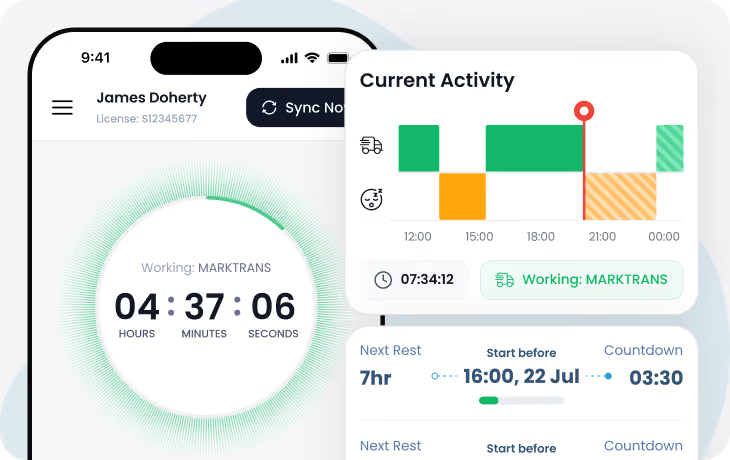
Electronic Work Diary
Digital logbook compliance for drivers, with fatigue rule enforcement and audit-ready shift records
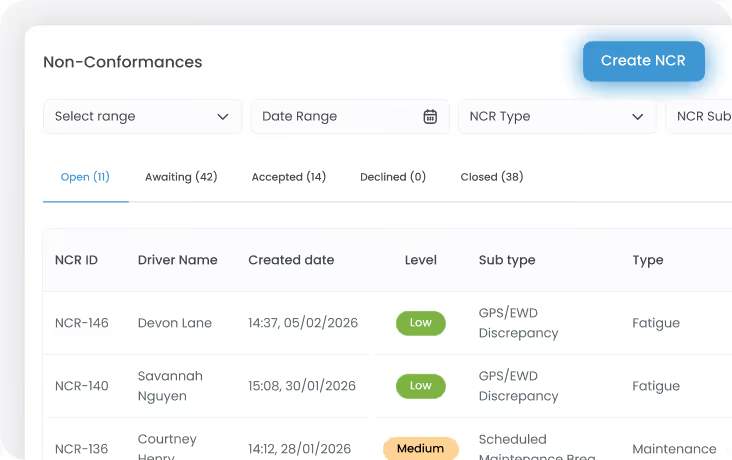
Non-Conformance Reporting
Create and track NCRs from missed or failed pre-start inspections
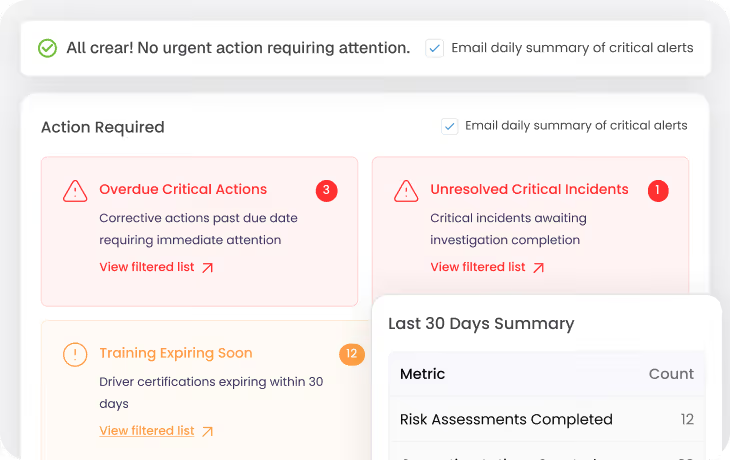
Safety Management System
Complete digital SMS platform covering all five HVNL2 outcome areas
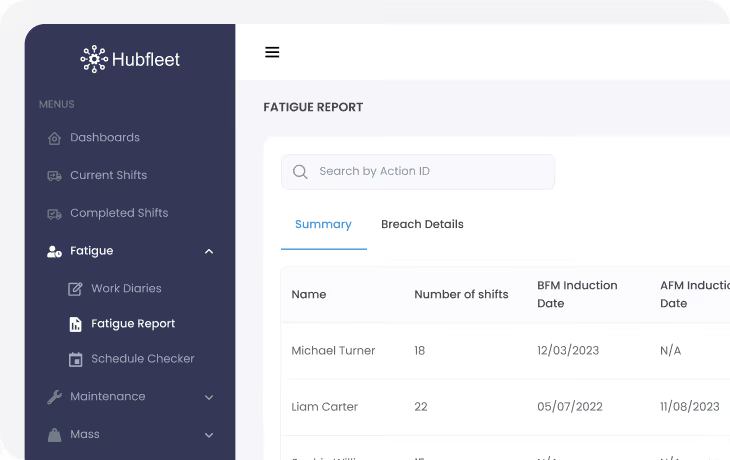
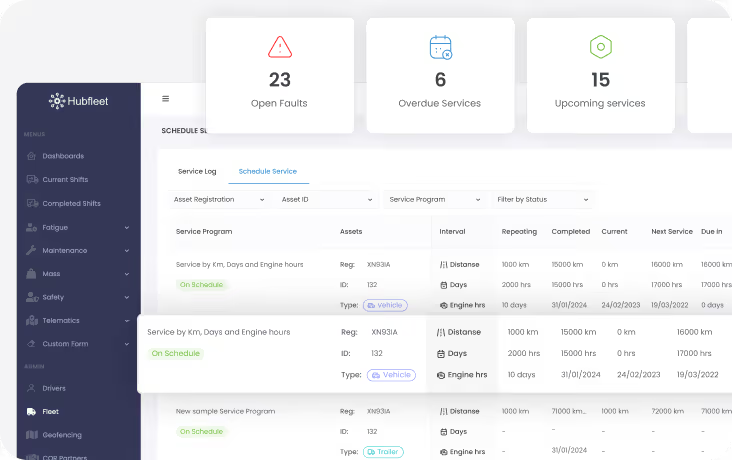
Fatigue Management
Monitor driver fatigue compliance alongside vehicle maintenance readiness
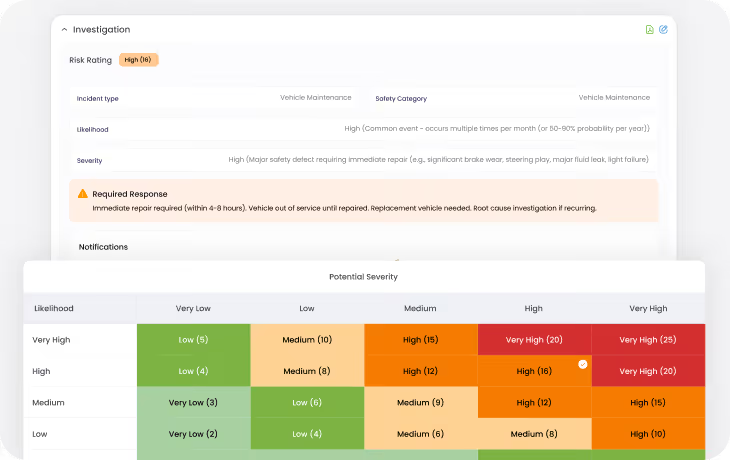
Risk Management
registers, risk assessments, and treatment tracking integrated with maintenance faults
HVNL2 Compliance Guide
Understand how the new Heavy Vehicle National Law affects your maintenance obligations
HVNL2 Compliance Guide
Understand how the new Heavy Vehicle National Law affects your maintenance obligations

Fatigue Management Best Practices

Fatigue Management Alternative Compliance
Fatigue Management

HVNL Reform Regulatory Analysis
SMS Requirements Explained
PSOE Evidence Framework Guide

HVNL Reform Implementation Roadmap

Fit for Duty
.avif)
Electronic Work Diary (EWD)

Hazard Reporting

Incident Reporting & Investigation
RIsk Controls
Training Management
Ready to close the local driver gap?

Start Free Trial
Recommended for most fleets
Best if you're ready to get drivers logging now and explore Hubfleet at your own pace.

Full platform access — every feature, no limits
Drivers can start on EWD today
Real EWD, SMS, and compliance reporting from day one
No upfront costs · No lock-in contract
Start Free Trial

Book your Demo
Best for larger fleets or complex setups
Best if you've got specific integration questions, multiple sites, or want a tailored walkthrough first.
Tailored to your fleet and use case
30 minutes with a Hubfleet specialist
See the platform mapped against your fleet's compliance obligations
Get HVNL and SMS questions answered live
Book your 30-Minute Demo
Want to see plans first?


500+ Australian operators
NHVR approved
Free trial
Australian-based support